

Photo: illustrative — a daughter and her mom looking through a photo album together at home. Stock photo by cottonbro studio via Pexels.
Visiting a parent with dementia for the holidays works best when you make the day smaller, earlier, and calmer than the holiday you grew up with. Keep the gathering short, plan it around the time of day your parent is usually at their best, and give them a quiet room to retreat to. Tell relatives ahead of time what to expect and how to visit — say your name, don't quiz, don't correct. The goal isn't the perfect Thanksgiving. It's a good few hours together, with nobody exhausted at the end of it.
Imagine this: say it's Thanksgiving morning, and you're driving to your mom's house with the pie in the passenger seat and a knot in your stomach. Last year she ran the kitchen. This year she asked three times what day everyone's coming — and called your sister by your name. You want the day to feel like it always did. You also know it won't. The families who have the best holidays are the ones who stop fighting that.
Thanksgiving falls on Thursday, November 26, and November is National Alzheimer's Disease Awareness Month — and National Family Caregivers Month, too. Roughly 7.4 million Americans age 65 and older are living with Alzheimer's in 2026, according to the Alzheimer's Association. If your parent is one of them, the holiday table is going to look different this year. Different can still be good.
How Do I Prepare Relatives Before the Holiday?
The kindest thing you can give your guests is a heads-up — before anyone walks in the door. Relatives who haven't seen your parent in months may be surprised by the changes, and surprise turns into awkwardness fast.
Send a short note to the family a few days ahead. Keep it simple: what has changed, what helps, and what to avoid. Something like: "Mom's memory is worse than the last time you saw her. She may not remember your name — please just say it when you walk in, like 'Hi Mom, it's Sarah.' Don't ask her to remember things or correct her when she gets something wrong. If she repeats herself, just answer again like it's the first time."
Give everyone one job they can actually do. One person brings the side dish you usually make so you can stay with Mom. One person keeps an eye on the quiet room. People want to help at a dementia-friendly holiday gathering — they just don't know what help looks like until someone tells them.
What Should the Day Itself Look Like?
Smaller, earlier, and shorter — that's the whole formula.
Eat at lunch, not dinner. Many people living with dementia do better earlier in the day. Confusion and restlessness that grow in the late afternoon — sundowning — are common, so a Thanksgiving lunch beats a long dinner that runs into the hardest hours.
Keep the crowd small at any one time. A full house, a football game on the TV, three conversations in the kitchen — that's a lot of noise for a brain that's working hard just to follow one voice. Stagger the visits if you can: the closest family first, while the house is still calm.
Set up a quiet room. A comfortable chair, soft light, a familiar blanket, maybe a photo album or a playlist of songs from your parent's younger years. When the noise builds, someone can walk with her to the quiet corner without it being a big deal.
Protect the routine. Meals, medications, and rest at the usual times matter more than the holiday schedule.
What If Mom Doesn't Recognize Everyone at the Table?
First, don't panic, and don't make it a test. Recognition with dementia often comes and goes — your parent may know your face perfectly at breakfast and struggle with it by dinner. It isn't about how much she loves you.
When you arrive, introduce yourself warmly: "Hi, Mom, it's me, your daughter." Sit at eye level, approach slowly, speak softly, and smile. If she calls you by your sister's name, don't correct her — just answer as yourself. Arguing with the confusion never brings the memory back.
Bring the traditions to her instead of asking her to keep up with them. A photo album, a favorite song, or a simple job she can still do can connect you in a way a quiz never will. Ask open-ended questions with no wrong answer: "What's your favorite thing about Thanksgiving?"
How Do I Handle Sundowning at a Holiday Gathering?
If the late afternoon starts to go wobbly — restlessness, pacing, more confusion, a sudden urge to "go home" from her own house — that's sundowning. Turn the lights up before dusk, turn the TV and music down, and move to the quiet room. Offer a warm drink, a blanket, a familiar face sitting close.
And give yourself permission to leave early. If your parent is tired, the day is done — even if the pie hasn't been served. Nobody will remember that you left at four. Everybody will remember whether the day felt kind.
Why I Built FairNest
I built FairNest — my own app for families coordinating care — because the hardest part of a holiday like this isn't the day itself. It's the week after, when four siblings all noticed something different and nobody wrote any of it down. Each of you saw one piece, and none of you has the whole picture.
That's what FairNest's handoff notes are for. After the visit, one person writes down what they noticed in the family's shared Nest, and the whole family can see it. It's free on iPhone and Android: FairNest on the App Store and FairNest on Google Play. Find us at getfairnest.com and on Instagram.
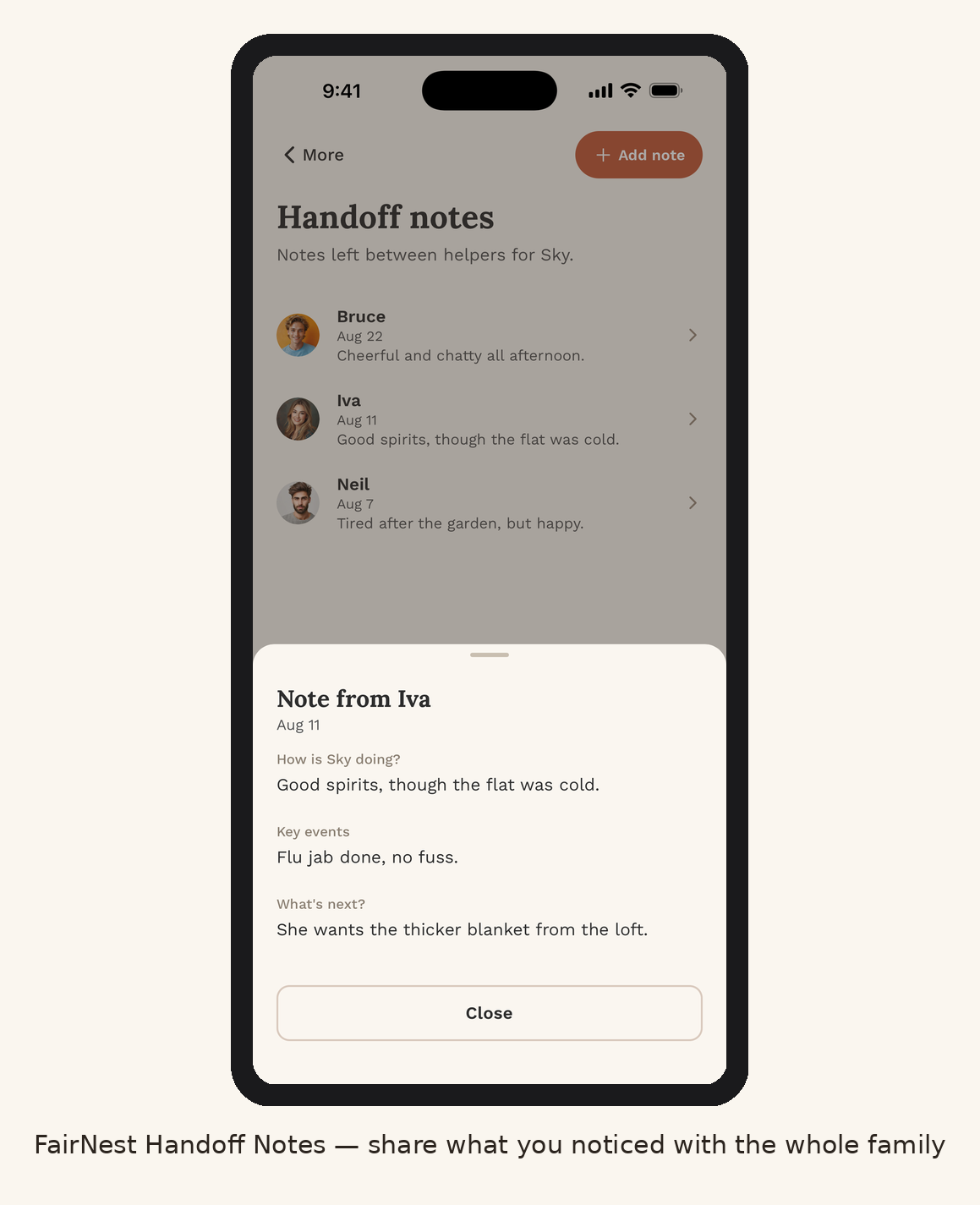
FairNest Handoff Notes — write down what you noticed at the visit so the whole family sees it in one place.
This isn't medical advice — if you're unsure about what's safe for your parent, talk to their doctor or care team about what's right for them.
Bottom line
Visiting a parent with dementia for the holidays isn't about recreating the old Thanksgiving. It's about a smaller, earlier, calmer day built around the person your parent is now. Keep it short, keep it warm, and leave before everyone is worn out. The best holiday you can give your parent this year is a day that feels safe. Everything else is just decoration.