

Photo: illustrative — an adult daughter and her elderly mom reviewing something together on a laptop in a bright kitchen. Stock photo by cottonbro studio via Pexels.
How to protect elderly parents from scams comes down to three things you can set up this week: a family code word no stranger can guess, a pause rule that says no money ever moves because of a phone call, and a way for the family to see the money together — so a strange withdrawal gets noticed in days, not months. No takeover of your parent's finances required — just eyes on the money.
Imagine this: say your mom calls you on a Tuesday afternoon, her voice shaking. "Your nephew's in jail," she says. "He called me, he sounded just like himself, he needs bail money and I can't tell anyone." She already sent the first payment. The voice on the phone wasn't your nephew — it was a recording, stitched together by software, and it knew his name, his voice, and exactly what to say to a grandmother who loves him.
That used to sound like a movie plot. In the past two weeks alone, Pennsylvania officials warned that scams targeting older adults are surging — fake arrest warrants, callers impersonating police, demands to feed cash into cryptocurrency machines. Federal prosecutors charged a man with stealing roughly $150,000 from his 78-year-old disabled veteran neighbor, and a $2.4 million scheme that stripped older Americans of cash and gold ended in an eight-year prison sentence.
What Scams Should Families Watch For Right Now?
The grandparent scam is the one to know first, because it works on love. A caller pretends to be a grandchild in trouble — an accident, an arrest, a trip gone wrong — and begs your parent not to tell anyone. The new twist is AI voice cloning: scammers can imitate a grandchild's voice from a few seconds of audio pulled off social media. The answer is always the same: hang up and call the grandchild back on the number you already have.
Then there's the fake authority call: someone claiming to be the police, the IRS, or a bank's fraud department, saying your parent's money isn't safe and must be moved — usually into a cryptocurrency machine or gift cards. Real officers and real banks never ask for that. Ever. If the caller says "don't tell your children," that's the scam announcing itself. Same with the pop-up warning that the computer has a virus, with a phone number to call for "tech support" — the "agent" talks your parent into handing over remote access, then bank details.
Here's the hardest part to say out loud: sometimes the person taking the money isn't a stranger. It can be a neighbor with a key, a hired helper, or even a family member. One elder-law professor put it plainly this month: roughly one in ten older adults experiences financial fraud, and more than half the time the person behind it is someone the family knows.
How Do I Talk to My Parent About Scams Without Sounding Condescending?
Start by making it about the scammers, not about your parent. "These people fool smart people for a living — doctors, lawyers, engineers. That's why we need a plan." Nobody wants a lecture from their own child about being gullible. Your parent isn't careless. They're kind, and kindness is exactly what the scam is built to exploit.
Then make the plan together, over coffee, at the kitchen table — not after something has already gone wrong. Agree on a family code word, something no stranger could guess, that any real grandchild would know in a true emergency. And agree on the pause rule: no money moves because of a phone call, a text, or a pop-up. The correct response to any urgent money demand is always the same: "I'll call you back on the number I have for you." A real emergency will still be there in ten minutes. A scam won't survive them.
What Guardrails Actually Protect an Aging Parent's Money?
You don't need to take over the checkbook. You need tripwires — small systems that catch a problem while it's still small.
First, turn on transaction alerts. Most banks will text or email you — and, with your parent's permission, a second family member — for withdrawals over an amount you choose, new payees, and large transfers. A strange $4,000 withdrawal should reach a family member's phone the same day, not at the end of the month when the statement arrives.
Second, look at the money together once a month. Sit down with your parent and the statements and go through them line by line — you're a second pair of eyes, not an auditor. Ask the bank about view-only access, so you can see the accounts without being able to move money, and about a credit freeze, which stops anyone from opening new accounts in your parent's name. It's free, and it's one of the strongest protections there is.
Third, simplify. One main checking account, bills on autopay, and a small separate account with a debit card for everyday spending — so even a bad day can't drain the account the mortgage comes out of. And keep one shared money log the whole family can see, so the missing $500 has nowhere to hide and no sibling has to wonder whether someone else is handling things.
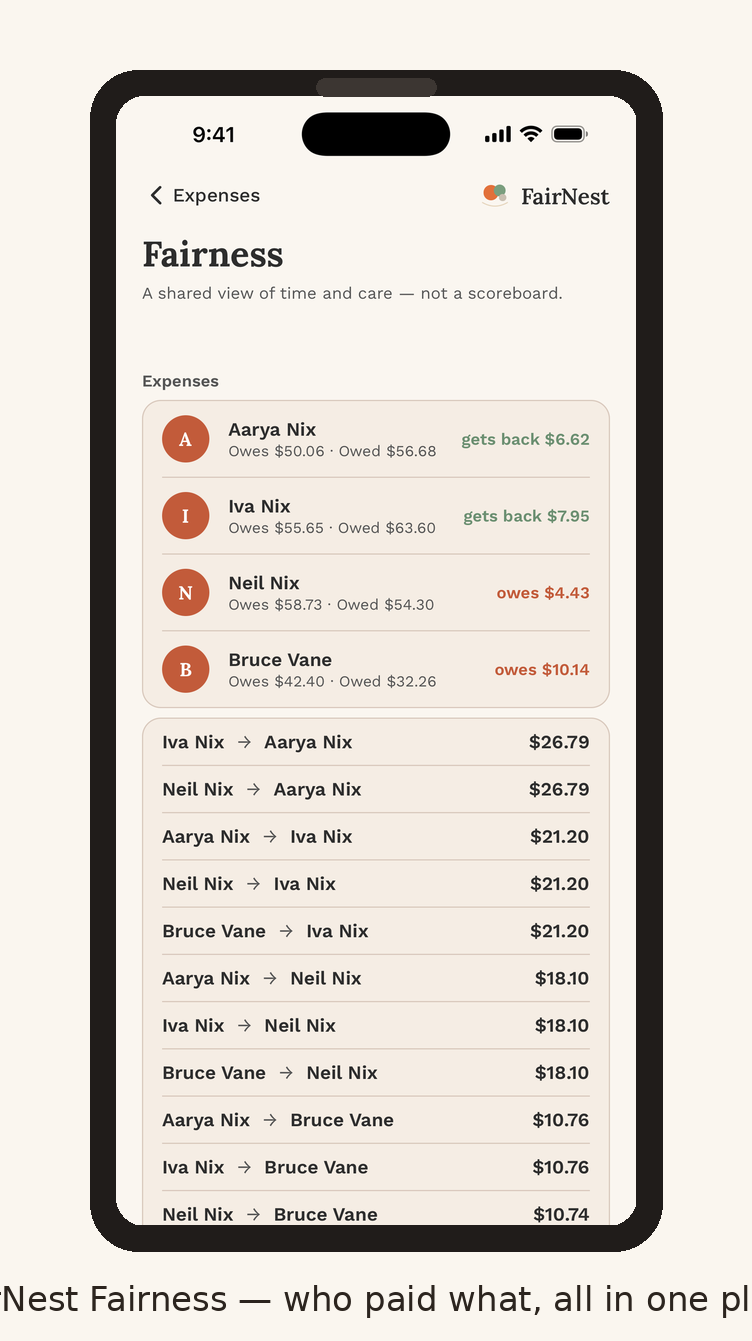
FairNest Fairness — who paid what, all in one place.
What Do I Do If My Parent Already Sent Money to a Scammer?
Act fast, and don't waste a minute on blame. Shame is the scammer's best friend — it's what keeps families quiet for the weeks that matter most. Call the bank immediately and ask to freeze the accounts and reverse what can still be reversed. Then report it: local police, the Federal Trade Commission at reportfraud.ftc.gov, the FBI's Internet Crime Complaint Center at ic3.gov, and the National Elder Fraud Hotline at (833) 372-8311. The AARP Fraud Watch Helpline at (877) 908-3360 can walk your parent through it, too.
If the person involved is someone the family knows, that's harder — and it's exactly when an outside report matters most. Adult Protective Services in your parent's state takes these reports, and you can make one without proof, just with concern.
Why I Built FairNest
I built FairNest because in my own family, the money was always the thing nobody could see clearly — receipts in a drawer, one sibling quietly floating the costs, everyone else guessing. So I built one shared Nest where the whole family works from the same picture: a shared cost log, the important documents in one place, and a handoff note when anything changes. It's my own app, built for families like ours — and a family that can see its money together is a family a scammer has a much harder time fooling.
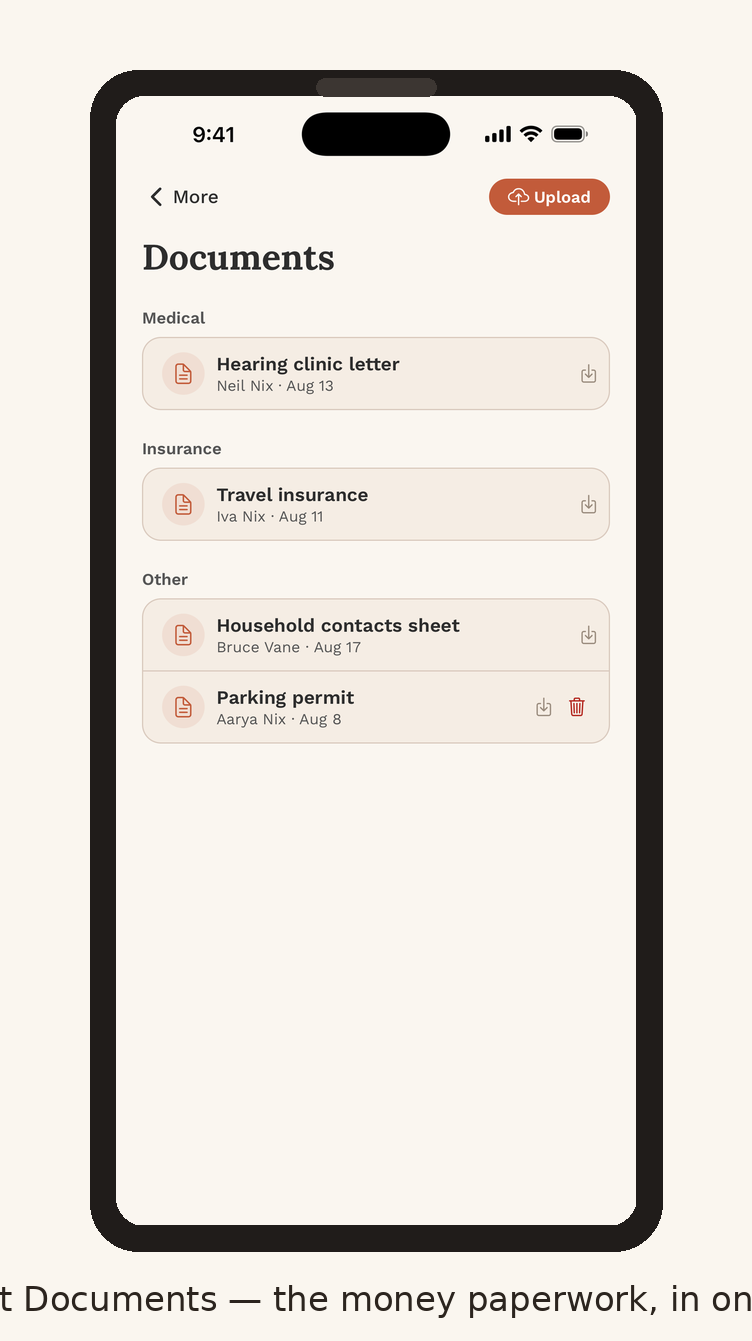
FairNest Documents — the money paperwork, in one place.
The scammers aren't going away. The calls will keep coming, and they'll keep getting more convincing. But a family with a code word, a pause rule, and eyes on the money together is a much harder target than a parent facing those calls alone. Have the conversation this week, while everything is calm.
Bottom line: Protecting an aging parent from scams means a family code word no stranger can guess, a pause rule that says no money ever moves because of a phone call, and tripwires — transaction alerts, a monthly look at the statements together, and a shared money log — so a strange withdrawal gets caught in days. And if money already went out, act fast and skip the blame: bank, police, reportfraud.ftc.gov, and the National Elder Fraud Hotline at (833) 372-8311.
This post is general information, not financial or legal advice — talk to your parent's bank or a trusted advisor about what's right for their situation. FairNest is my family caregiving app — one shared Nest for tasks, coverage, handoff notes, cost splitting, and med tracking. Find it free on the App Store at https://apple.co/4xRXJuq and on Google Play at https://play.google.com/store/apps/details?id=com.bizvizorllc.fairnest, and follow along at https://www.instagram.com/fairnestapp/.