

Photo: illustrative — two sisters talking things through over breakfast. Stock photo by Tiger Lily via Pexels.
To keep family updated on a parent's care without living in the group chat, write one short update in one shared place: what changed, what's next, and what you need from anyone. One update, written once, that everyone can find — on a regular rhythm — beats twenty scattered texts.
Imagine this: you just got home from taking your mom to the doctor. It was a long appointment, the news was mixed, and you're still turning it over in your head when your phone starts buzzing. Your sister wants to know what the doctor said. Your brother wants to know if Mom needs a ride on Thursday. Someone asks about the new prescription, someone else asks if anyone called the pharmacy — and by the time you've answered everyone separately, you've told the same story four times, each version slightly different.
If you're wondering how to keep family updated on a parent's care, here's the hard truth most families learn the slow way: the group chat isn't a care plan. It's a junk drawer. Important news sinks under birthday memes within hours, the sibling who reads everything still misses the one message that mattered, and the person who was actually at the appointment ends up as the family's unpaid switchboard operator — retelling the same story four times, each version slightly different. Nobody means to make it this hard. It just happens, because nobody ever set up a better system.
The fix isn't more communication. It's less, but better. One update, written once, that everyone can find.
How Do You Keep Family Updated on a Parent's Care Without Living in the Group Chat?
1. Write it once, in one place — then stop repeating yourself. The single biggest time-saver in family caregiving is refusing to be the switchboard. After an appointment, a bad night, or any change worth knowing about, write the update once, in the one place everyone has agreed to check — a shared care log for elderly parents, not a group chat thread that buries it under birthday memes. Then, when your brother texts "what did the doctor say?" you can point him to the update instead of retyping it. This isn't being cold. It's being fair — to yourself, and to the siblings who deserve the same version of the story everyone else got. If the update lives in a shared spot instead of scattered across text threads, nobody has to wonder whether they missed something, and nobody has to ask you to say it all again at 9 p.m.
2. Lead with what changed. Most care updates fail because they're either a wall of detail or a shrug — "Mom's fine" tells your siblings nothing, and a blow-by-blow of a forty-minute appointment tells them more than they can use. The sweet spot is short and structured: what changed since the last update, what's next, and what you need from anyone. "Mom's new blood pressure pill starts tomorrow, morning dose. Follow-up in three weeks. I need someone to cover Thursday morning." Three sentences. Everyone's caught up, nobody's confused. If nothing changed, say that too: "No changes this week, same routine" is a perfectly good update — and a reassuring one.
3. Decide who needs to know what. Not everyone in the family needs the same level of detail, and pretending otherwise is how updates get ignored. The siblings sharing the care need the full picture: meds, appointments, what's worrying you. The cousin who checks in once a month needs the headline, not the dosage schedule. That's not secrecy — it's respect for people's attention. Keep the detailed updates in the shared spot for the people doing the work, and send the wider circle a short version when there's real news. The moment people learn your updates are short and worth reading, they actually start reading them.
How Often Should You Update Your Family on a Parent's Care?
4. Set a rhythm, and let the rhythm do the work. A weekly update at the same time beats twenty scattered texts. Pick a slot — Sunday evening works for a lot of families — and make it the moment the week's news lands, whether there's big news or not. "Dad had a good week, ate well, no falls, PT on Tuesday" takes two minutes to write, and it quietly proves the system is working. Your siblings stop texting "any news??" because they know when the news arrives. And when something genuinely urgent happens, the midweek message stands out — because it isn't the fifteenth message of the day.
5. Let the update be boring. This is the one nobody wants to hear. Caregiving updates that work are a little dull by design: same format, same place, same time. The drama is in the situation, not in the delivery. The family that updates well doesn't have a better group chat — it has something calmer than a group chat. A shared log where anyone can catch up in thirty seconds, where the last update is always the current truth, and where nobody has to scroll through a hundred messages to find out whether Mom took her pill on Tuesday. Boring is the goal. Boring means nobody missed anything.
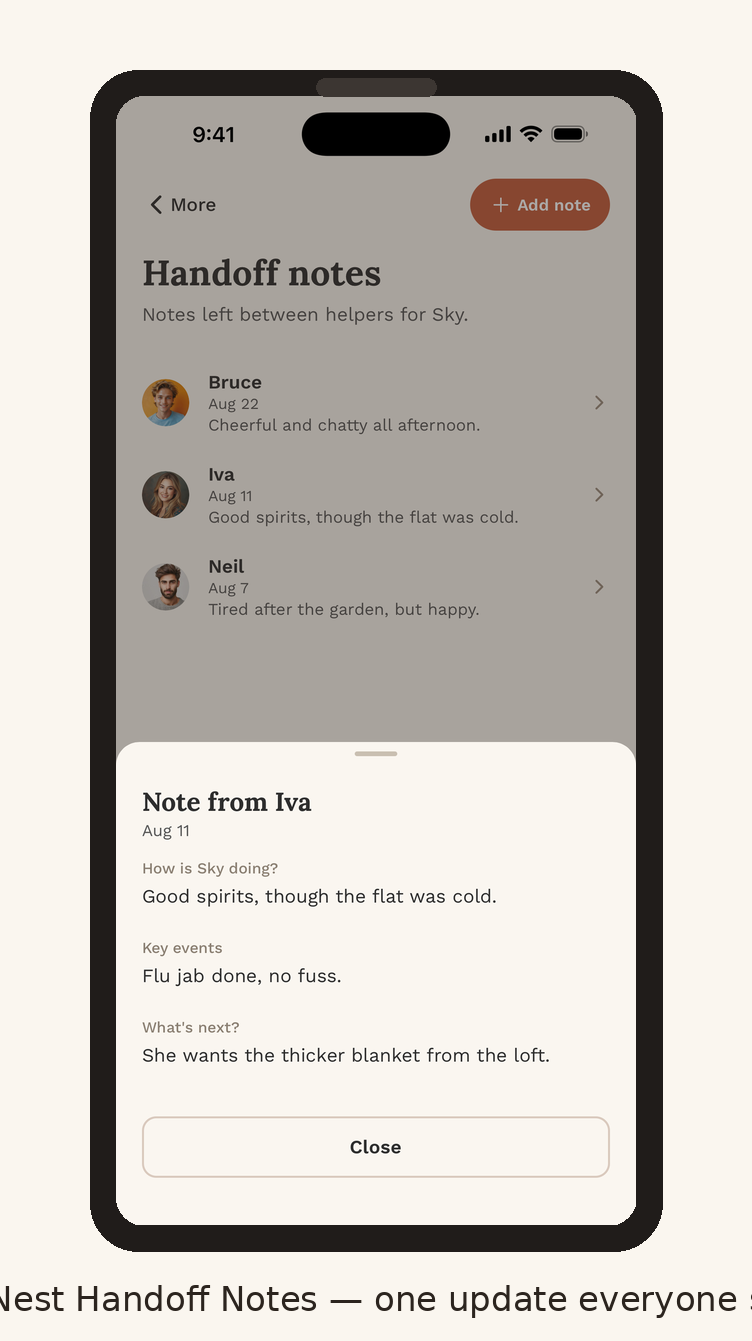
FairNest Handoff Notes — one update everyone sees, so the whole family stays on the same page.
Why I Built FairNest
I built FairNest because I watched a family run their entire care plan through a group chat, and I watched it fail in exactly the ways group chats always fail. One sibling had the real story, the others had fragments, and the person who knew the most was the person doing the most — and the most exhausted. In our Nest, the update goes in once — a handoff note, a change in coverage, a med marked given — and everyone sees the same thing. No retelling, no "wait, which version did you hear," no 9 p.m. replays. It's my own app, built for families like ours. You can find it at getfairnest.com.
You don't need a perfect system to start. You need one place, one rhythm, and one rule: write it once, where everyone can find it. Try it this week — one short update, in one shared spot. Your siblings will catch up faster, you'll stop repeating yourself, and the next time someone asks "what did the doctor say?", you'll have an answer that doesn't cost you another twenty minutes of your evening.
Bottom line: You don't need a perfect system to keep family updated on a parent's care. You need one place, one rhythm, and one rule: write it once, where everyone can find it. Try it this week — one short update, in one shared spot.
This post is general information, not medical advice — if a health question comes up in your parent's care, their doctor is the right person to ask. FairNest is my family caregiving app — one shared Nest for tasks, coverage, handoff notes, cost splitting, and med tracking. Find it free on the App Store at https://apple.co/4xRXJuq and on Google Play at https://play.google.com/store/apps/details?id=com.bizvizorllc.fairnest, and follow along at https://www.instagram.com/fairnestapp/.