

Photo: illustrative — a grandmother and her granddaughter looking at a photo album together. Stock photo via Pexels.
To explain dementia to a child, keep it simple and honest: Grandma's brain is having trouble holding on to new memories, it isn't anyone's fault, and she still loves them exactly the same. Give the child one or two sentences they can repeat, name the feelings, and give them something useful to do on the next visit.
Imagine this: you're driving home from Sunday lunch at your mom's house, and your seven-year-old pipes up from the back seat: "Why does Grandma keep asking me the same question? I already told her three times." You glance in the rearview mirror. She's not being rude — she's confused, and a little hurt, because Grandma used to remember everything. If you've been wondering how to explain dementia to a child, you're not alone — it's one of the hardest conversations in caregiving, because you're translating something you barely understand yourself into words a kid can hold on to.
Here's the good news: kids are better at this than we think. They don't need a medical lecture — just a simple, honest story, permission to feel whatever they feel, and something useful to do the next time they see Grandma. And it doesn't have to happen all at once; the best explanations come in small pieces, right when the questions come up.
How to Explain Dementia to a Child: Start With What They Can See
Kids understand what they can observe, so start there — not with a diagnosis. "You noticed Grandma asks the same question a lot. You're right, she does. Her brain is having trouble holding on to new memories, the way a pocket with a hole in it can't hold coins. The memories from long ago are still there. It's the new ones that slip away."
That one image — a pocket with a hole in it — does more work than any pamphlet. It tells them what's happening without scaring them, and it gives them language they can use themselves the next time they're confused. Grandma isn't doing this on purpose, and it isn't anyone's fault.
Here are five ways to make the conversation land.
1. Keep it simple, and keep it true. One or two sentences a child can repeat back is enough. "Grandma's brain is getting forgetful, and the doctors say it will keep getting more forgetful. She isn't going to get better, but she still loves you exactly the same." Don't promise she'll improve — kids remember promises, and a broken one feels like a lie.
2. Answer the question they actually asked. Kids ask small questions, and they want small answers. When your daughter asks, "Will Grandma forget me?" she needs a small answer, not a speech: "She might forget your name sometimes. But she never forgets how happy she feels when you're around — you can see it on her face the second you walk in." Answer the question in front of you, then stop. If they want more, they'll ask.
3. Name the feelings — theirs and yours. A lot of kids feel guilty for being annoyed when Grandma repeats herself, or scared the same thing will happen to you. Say it out loud before they have to: "It's okay to feel sad about this. It's okay to feel frustrated, too. Sometimes I feel that way, and I'm a grown-up." When a feeling gets named, it gets smaller. When it stays secret, it grows.
4. Give them a job. The worst part of watching someone change is feeling helpless, and kids feel that just like we do. So give them a role for the next visit — helping kids understand Alzheimer's gets easier when they have something to do, not just something to hear: hold her hand on the walk to the kitchen, look through the old photo albums with her, tell her about school. Connection doesn't need memory — and a grandchild who knows what to do walks in with confidence instead of dread.
5. Prepare them for the hard moments, gently. Before a visit, a one-minute preview goes a long way: "Grandma might call you by the wrong name today, or ask the same thing a few times. None of that means she loves you less — her brain just mixes things up now. And if a visit feels hard, it's okay to step outside for a bit." Kids handle hard things far better when they see them coming.
What Do I Say When Grandma Forgets Their Name?
This is the moment most parents dread, and it will probably happen — maybe it already has. Talk about it on the car ride home, not in the moment, in front of her.
Try something like: "Grandma's brain mixed up the names today. But did you see how her whole face lit up when you walked in? She knows you're her person, even when the name doesn't come out right." Let your kid feel whatever they feel about it — a shrug, tears, both are fine. What matters is that they hear, from you, that forgetting a name is a brain problem — not a love problem.
And don't correct Grandma in front of your child, or ask your child to correct her. A gentle "that's your granddaughter, Mom — she just got back from soccer" keeps everyone's dignity intact.
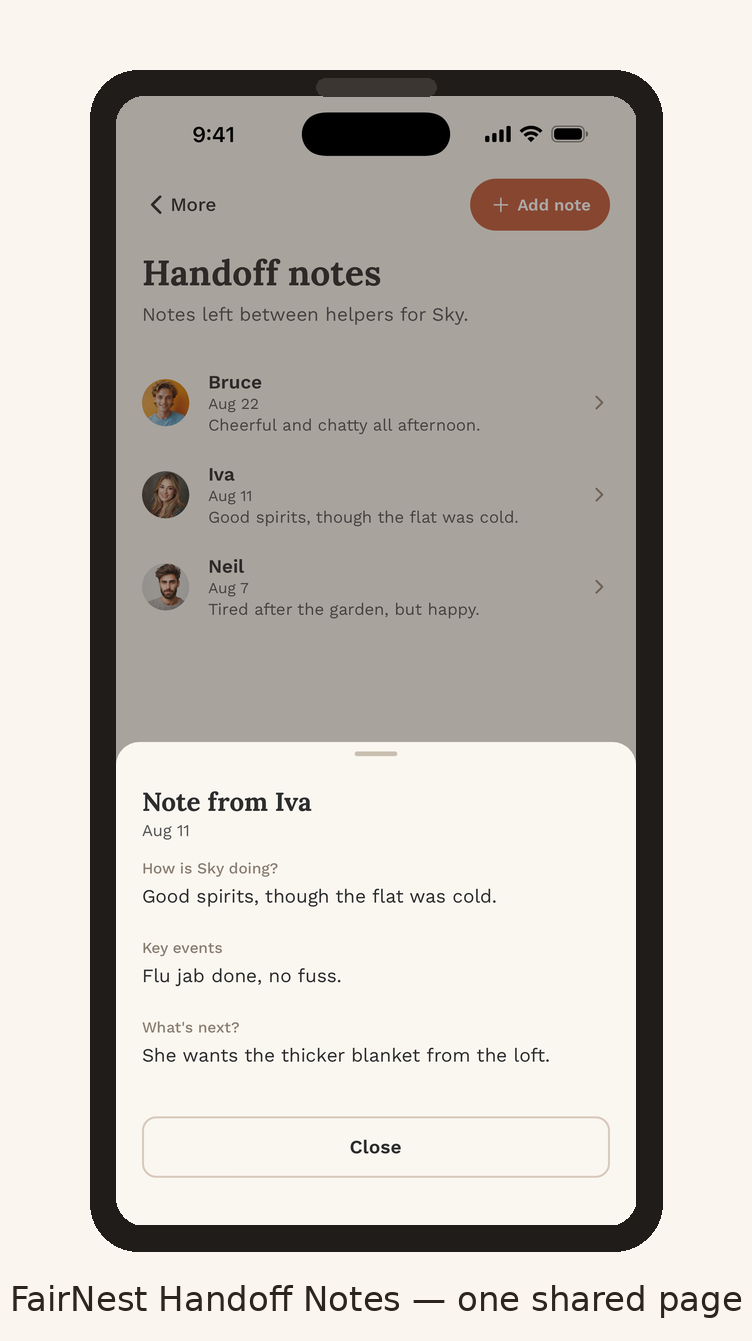
FairNest Handoff Notes — one shared page for the whole family, so everyone tells the kids the same story.
How Do You Keep the Whole Family Telling Kids the Same Story About Dementia?
One thing that helps more than any single conversation: when the adults agree on the simple version. If Mom says "Grandma's just tired" and Dad says "Grandma's brain is sick" and an aunt says nothing at all, your kid gets three different stories and trusts none of them. Agree on the words you'll all use, and write them down somewhere everyone can see them. In our Nest, the handoff notes hold exactly that — what helps Mom today, what upsets her, what the kids can do when they visit — so the whole family tells the same story.
Why I Built FairNest
I built FairNest because I've seen what happens when the important details of a parent's care live in one person's head. One sibling knows what Mom needs today, the others are guessing, and the grandkids get a different explanation from every adult they ask. In our Nest, tasks, coverage, handoff notes, and med tracking sit in one shared place, so the family is working from the same page — and the kids hear one steady story, not five confusing ones. It's my own app, built for families like ours. You can find it at getfairnest.com.
Your kid doesn't need you to have the perfect words. They need to know it's okay to ask, it's okay to feel sad, and Grandma is still Grandma — even on the days her memory isn't. Start with one honest sentence, the next time the question comes up in the back seat. That's enough.
Bottom line: Your kid doesn't need you to have the perfect words for explaining dementia to grandchildren. One honest sentence, permission to feel whatever they feel, and a small job for the next visit are enough — Grandma is still Grandma, even on the days her memory isn't.
This isn't medical advice — if you're worried about a parent's memory, their doctor is the right first call. FairNest is my family caregiving app — one shared Nest for tasks, coverage, handoff notes, cost splitting, and med tracking. Find it free on the App Store at https://apple.co/4xRXJuq and on Google Play at https://play.google.com/store/apps/details?id=com.bizvizorllc.fairnest, and follow along at https://www.instagram.com/fairnestapp/.