

Photo: illustrative — an elderly father and his adult daughter in a serious conversation at home. Stock photo via Pexels.
Talking to aging parents about money works best as a series of small conversations, not one big sit-down: lead with care, ask about how their money works rather than the balance, bring siblings in early, and write down the essentials together. Done early and gently, it's one of the kindest things you can do for a parent — and for yourself.
Imagine sitting at your dad's kitchen table on a Sunday afternoon, coffee going cold between you, trying to ask the question that's been sitting in your chest for months: Dad, are the bills getting paid? You open your mouth, and what comes out is something about the weather instead. Because asking your parent about money feels like asking them to hand over the keys to their independence — and nobody wants to be the kid who did that.
If you've been putting off figuring out how to talk to aging parents about money, you're in good company. Most families wait for a crisis — a missed payment, a stack of unopened envelopes, a scam — before the conversation finally happens, in a hospital waiting room. Done early and done gently, it's one of the kindest things you can do for a parent — and for yourself.
How Do I Start Talking to Aging Parents About Money?
The single biggest mistake families make is treating the money talk like one big event — a single sit-down where everything gets laid on the table. That framing is what makes it terrifying: your parent hears "we're taking over," and you hear "I'm about to ruin Sunday dinner." Nobody wins.
Instead, think of it as a series of small conversations, spread over weeks, each one covering one small piece. You're not auditing your parent. You're building a map together, one landmark at a time, so that if anything ever goes sideways, nobody is guessing in the dark.
Here are five ways to do that.
1. Lead with care, not control. The words you choose matter more than the topic. "I want to make sure you're taken care of" lands very differently from "I need to see your accounts." Try: "If something ever happened and you couldn't pay a bill for a month, who would you want to handle it?" That's a question about their preferences, not their bank balance — and it opens the door to the practical stuff.
2. Ask about the system, not the balance. You don't need to know how much money your parent has — just how their money works: which bank, where the bills get paid from, whether anything is on autopay, and where the paperwork lives. Ask to see the system, not the numbers. "Can you show me how you pay the electric bill, so I could do it if you were ever in the hospital?" Most parents can say yes to that — because it's about helping, not inspecting.
3. Bring your siblings into the conversation early. Money is the fastest way to turn a caregiving disagreement into a family fight, and secrecy is the fuel. If one sibling knows where the accounts are and the others don't, resentment builds even when nobody did anything wrong. Get everyone on the same page before there's anything to argue about: who knows what, who can step in, and how to split caregiving costs with siblings if care gets expensive. Put the agreements somewhere the whole family can see them — the goal isn't to make everything equal; it's to make everything visible.
4. Write down the essentials, together. The most valuable document in a caregiving crisis isn't a will or a power of attorney — though both matter, and a lawyer can help with those. It's a simple one-page list — your elderly parent finances checklist: account names, monthly bills and when they're due, insurance policies, and where the important papers live. Build it together, on a calm afternoon, with your parent holding the pen. When they write it, it's their plan. When you write it for them, it feels like a takeover. That one difference is everything.
5. Agree on a trigger for stepping in — before you need one. The hardest part of helping a parent with money is knowing when to move from "standing by" to "stepping in." So decide together, while things are calm, what would have to happen for you to step in? Unpaid bills two months in a row? A confusing phone call from a "bank" asking for passwords? A doctor saying memory is slipping? Naming the trigger in advance takes the guilt and the guesswork out of it — you're keeping a promise you made together, not deciding for them.
What If the First Money Talk With a Parent Goes Badly?
The first money talk is the hardest one by far. The second is easier. By the third, your parent may be the one bringing it up — because the secrecy was weighing on them too. Most aging parents aren't hiding their finances. They're embarrassed, or overwhelmed, or simply don't know where to start. Somebody has to go first, and that somebody is usually you.
And if it goes badly the first time — if your mom shuts it down, or your dad gets defensive — that's not failure, it's information. The topic feels threatening, so find a smaller door in: a story about a friend's parent, a news article about a scam — scam protection for elderly parents is a natural way into the money conversation — a question about one bill instead of all of them. Come back in a week. Gentleness is a strategy, not a weakness.
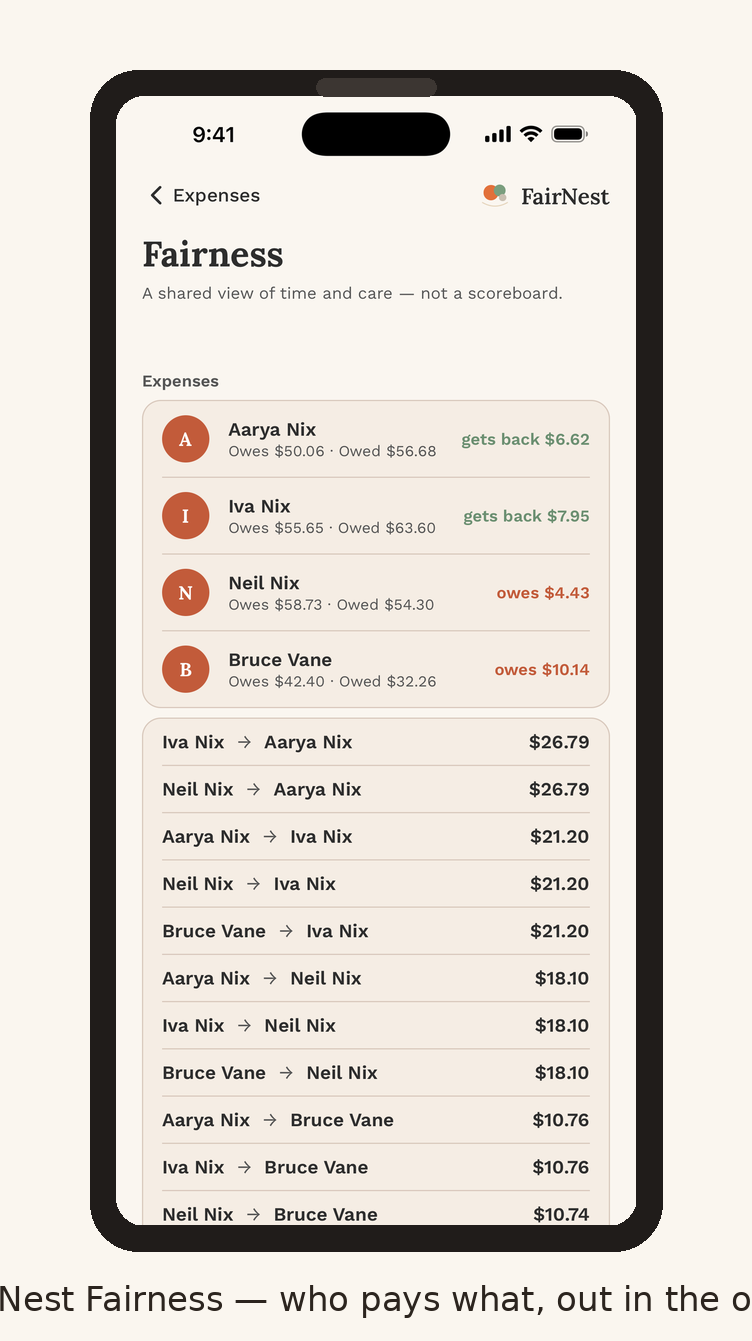
FairNest Fairness — who pays what, out in the open, so money never becomes a family argument.
Why I Built FairNest
I built FairNest because I've seen what happens when money stays a mystery inside a family. One sibling quietly pays for everything and burns out. Another has no idea what's been spent and feels shut out. The parent in the middle feels like a burden. None of that is anyone's fault — it's what happens when the numbers live in one person's head.
In our Nest, cost splitting sits right alongside tasks and coverage, so everyone can see what was spent, who paid, and what's fair — without a single awkward conversation. It's my own app, built for families like ours, where the money part of caregiving shouldn't be the part that breaks the family. You can find it at getfairnest.com.
Your parent spent decades handling their own money, and that independence matters — it should. Talking about money isn't taking it away. It's making sure that when they need help, the help is already organized, the family already agrees, and nobody has to decide in the middle of a crisis. Start small. Start now. And let them hold the pen.
Bottom line: Talking to aging parents about money isn't taking their independence away — it's making sure that when they need help, the help is already organized and the family already agrees. Start small, start now, and let them hold the pen.
This isn't financial advice — talk to a financial advisor or an elder-law attorney about what's right for your family. FairNest is my family caregiving app — one shared Nest for tasks, coverage, handoff notes, cost splitting, and med tracking. Find it free on the App Store at https://apple.co/4xRXJuq and on Google Play at https://play.google.com/store/apps/details?id=com.bizvizorllc.fairnest, and follow along at https://www.instagram.com/fairnestapp/.