

Photo: illustrative — two sisters talking through their parent's care over coffee. Stock photo by alda2 via Pixabay.
To stop being the only sibling doing the caregiving, make the invisible work visible: list every task for a week, share it, then ask for one specific thing at a time and move the knowledge — medications, appointments, coverage — into one shared place. The pattern changes with small, deliberate moves, not one big blowup.
Imagine this: your phone buzzes at 7 a.m. and it's the pharmacy — Mom's prescription needs a prior authorization, again. You handle it before your first coffee, because you're the one who always handles it. By noon you've called the doctor's office, rescheduled the home aide, and answered three texts from your brother asking how Mom is doing. He means well. He also hasn't driven her to a single appointment in months. And somewhere between the pharmacy hold music and the group chat, a thought you've been pushing down finally surfaces: how did I become the only sibling doing the caregiving?
If that sounds familiar, you're not alone — and you're not imagining it. In most families, one sibling quietly becomes the default. Not because anyone voted, but because they lived closest, or answered the phone first, or were "good at that stuff." The rest of the family gets used to it. And the default sibling gets used to being tired.
Being the one who does everything isn't a personality trait. It's a pattern — and patterns can change, not with one big blowup, but with a few small, deliberate moves.
How to Stop Being the Only Sibling Doing the Caregiving: Start by Making the Work Visible
The first move isn't a confrontation. It's a list.
Most of the work the default sibling does is invisible — the kind nobody counts because it happens in ten-minute bursts between everything else. If you're the only sibling doing all the caregiving, that invisibility is the trap: the calls, the refills, the scheduling, the checking in, the worrying at 2 a.m. Write it all down for one week: every caregiving task, how long it took, and who did it. Don't editorialize. Just list it.
Then share the list with your siblings. Not as an accusation — as information. Most siblings genuinely don't know how much there is, because the setup was designed, accidentally, so they'd never have to find out. A plain list of twenty-three tasks in a week does more persuading than a year of hints.
How Do I Ask a Sibling to Help With Caregiving Without Starting a Fight?
"Can you help more?" is the request most likely to go nowhere, because nobody knows what it means. Your brother hears "help more" and thinks he already does — he called last Sunday, after all. Be specific instead: "Can you take Mom to her cardiology appointment on the 18th? It's at 10, it takes about two hours, and I'll send you the address." A specific ask has a date, a job, and an ending. It's easy to say yes to, and every yes is a small transfer of the load.
Start with one ask. You're not rebuilding the family in a weekend — you're proving that the load can move.
How Do You Split Caregiving Fairly When Siblings Can't Do the Same Things?
Here's a truth that stings a little: not every sibling can do the same kind of helping, and insisting they do it your way is a recipe for a fight. The brother who lives three states away can't do Tuesday dinners, but he can own the bills, research the home-care agency, or call Mom every evening. The sister who freezes at the sight of a pill organizer might be brilliant at the insurance paperwork.
Fair doesn't mean identical. It means everyone carries something real. Offer the menu — rides, money, admin, calls, weekends — and let each sibling choose a lane they can actually keep. Then write it down, so the agreement survives the first busy week.
What Happens When Only One Sibling Knows Everything About Mom's Care?
The real trap of being the default sibling isn't the tasks. It's the knowledge. You're the only one who knows which pills changed, what the doctor said, when the aide comes, where the insurance card is. That makes you indispensable — and exhausted.
So move the knowledge out of your head into one shared place: a simple list of medications, appointments, and who's covering what this week. When the information is visible, the work becomes visible too — and it's much harder for a sibling to assume everything is handled when they can see the empty Thursday slot with their own name nowhere near it.
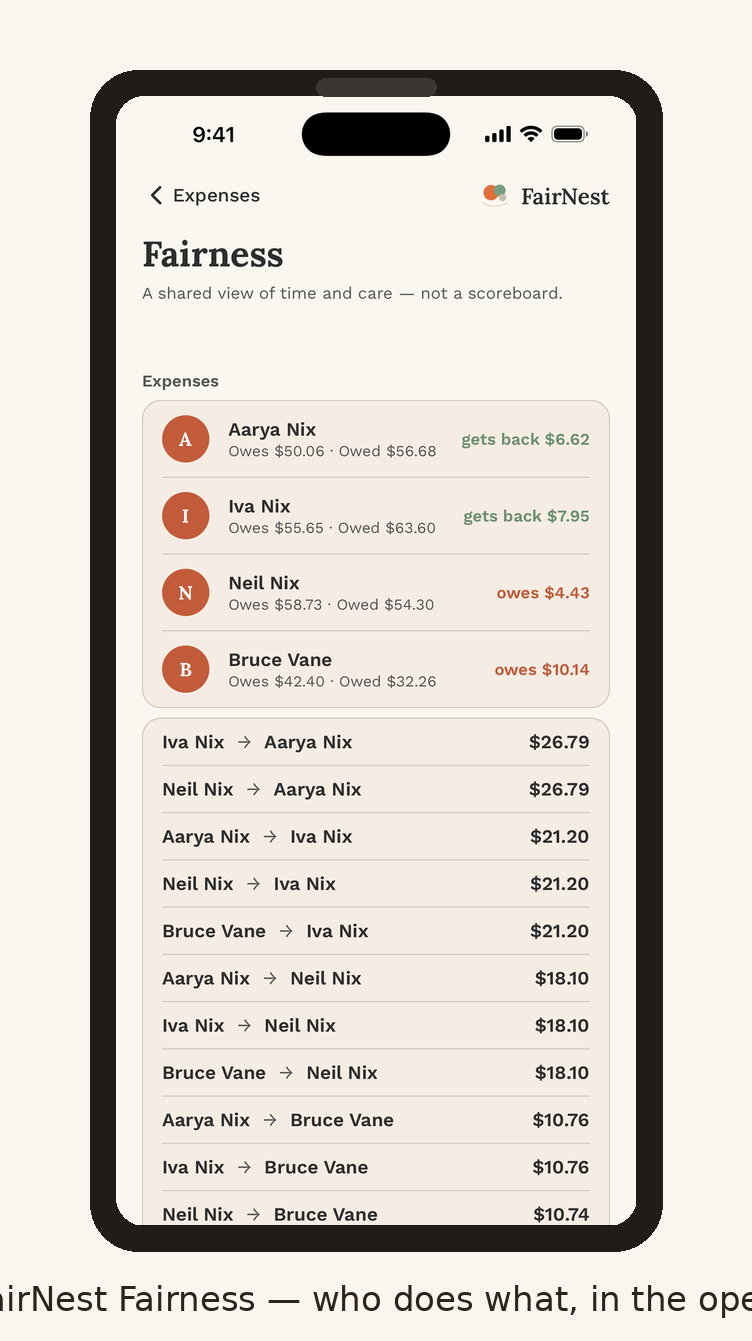
FairNest Fairness — who does what, in the open.
Set a Boundary You Can Actually Keep
The last move is the hardest: decide what you will stop doing, and say it plainly. Not as a threat. As a fact. "I can't keep doing the weekday appointments and the night calls. Starting next month, I need someone else on Wednesdays." Then hold the line when Wednesday comes — have the plan ready in advance, don't hope someone steps up in the moment.
Boundaries aren't ultimatums. They're what keeps you caregiving for the long run instead of burning out and resenting the people you love most. The goal isn't to quit — it's to still be standing, and still liking your siblings, a year from now.
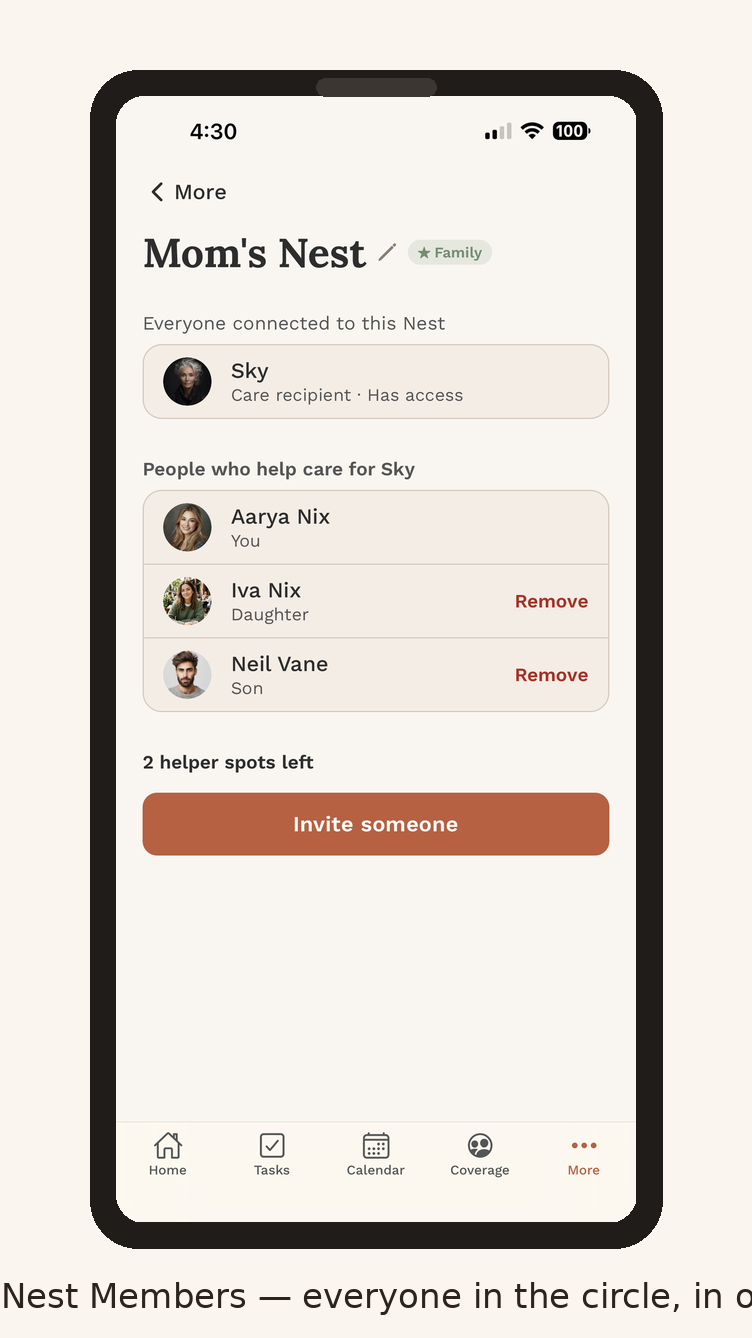
FairNest Nest Members — everyone in the circle, in one place.
Why I Built FairNest
I built FairNest because in too many families, the caregiving plan lives in one person's head — and that person is drowning in it. In our Nest, the coverage, the tasks, and the handoff notes sit in one shared place, so the load is visible to everyone, not just the sibling carrying it. Nobody has to remember everything, because the family remembers it together.
It's my own app, built for families like ours — the ones where one person has quietly been doing everything, and everyone else would help if they could only see what "everything" actually is. You can find it at getfairnest.com.
You didn't become the default sibling because you're the only one who cares — you became the default because you showed up first, and then kept showing up. The way out isn't to show up less. It's to make the work visible, ask for one specific thing at a time, and let your siblings carry their share. Your parent needs the whole family. And so do you.
Bottom line: You became the default sibling because you showed up first — not because you're the only one who cares. Make the work visible, ask for one specific thing at a time, and move what you know into one shared place so the load — and the care — is finally shared.
FairNest is my family caregiving app — one shared Nest for tasks, coverage, handoff notes, cost splitting, and med tracking. Find it free on the App Store at https://apple.co/4xRXJuq and on Google Play at https://play.google.com/store/apps/details?id=com.bizvizorllc.fairnest, and follow along at https://www.instagram.com/fairnestapp/.