
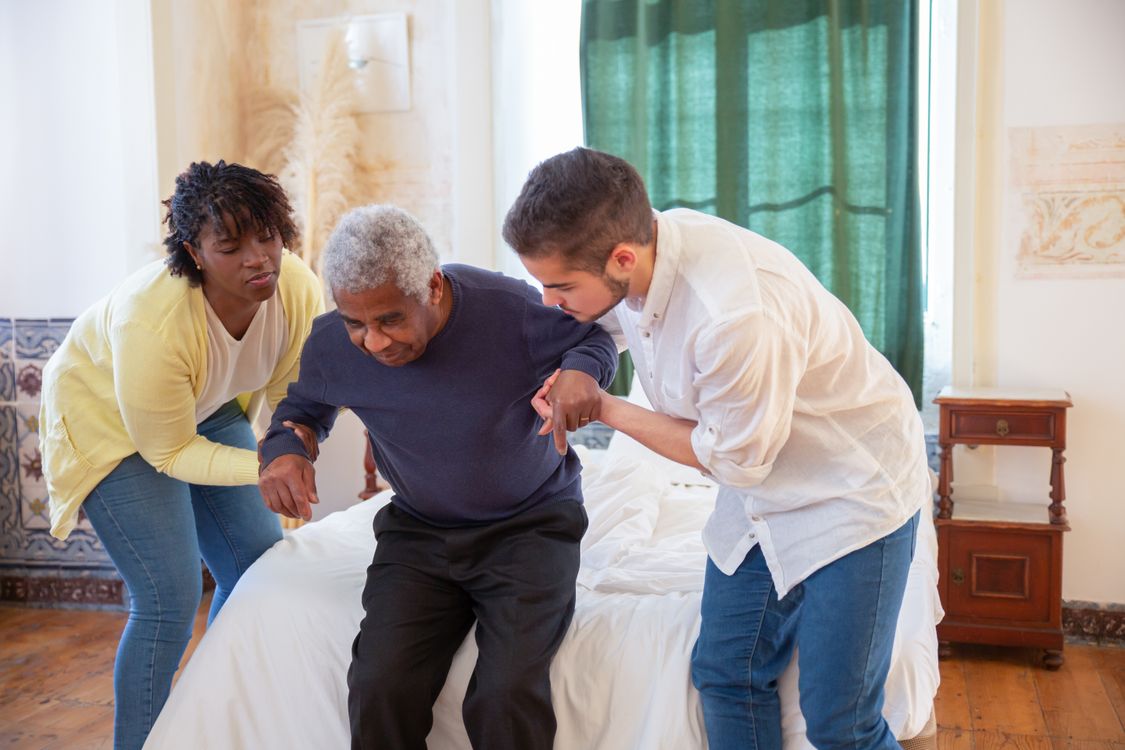
Photo: illustrative — two caregivers helping an elderly man stand at home. Stock photo by Kampus Production via Pexels.
Handing off care to a home health aide works when the details only your family knows are written down before the first visit: the daily routine, medications and timing, the quirks, and what calms your parent down. A short "day in the life" note, a first visit done in person, and one shared place for updates keep the handoff from falling apart.
Say your dad is coming home from the hospital on Tuesday, and for the first time, someone who isn't family will be there when you can't be. A home health aide — kind, trained, professional — walks in on Wednesday morning, and suddenly you realize how much of your dad's care lives only in your head. Which pills with breakfast, which without. That he hates the shower chair but loves a warm washcloth. That he gets anxious after 4 p.m. and calms down if the radio is on. That he will absolutely tell a stranger he's "fine" when he is not fine at all.
That is the moment most families discover the real challenge of hiring help. It's not finding the aide. It's the handoff — getting everything you know out of your head and into a form someone new can actually use.
What Should I Write Down Before a Home Health Aide's First Visit?
Before the aide's first shift, sit down for twenty minutes and write out a plain-language day in your parent's life — your home health aide handoff checklist in human form: wake-up time, meals, medications and when they go with food, the afternoon walk, the evening routine, the quirks. Not a medical chart — a human one. "Dad takes his blood pressure pill with breakfast, not before. He naps from 2 to 3 and wakes up groggy — give him ten minutes before asking him anything. He pretends he ate lunch; check the plate."
This is the single most useful document you'll ever make as a caregiver, and it does double duty: your siblings can read it, a substitute aide can read it, and the next family member who covers a shift doesn't have to guess.
Do the First Handoff in Person, Out Loud
Don't just leave a binder on the kitchen counter and hope for the best. Be there for the first hour of the first visit, if you possibly can. Walk the aide through the house the way you'd walk a friend through it: where the towels are, which door sticks, where the blood pressure cuff lives, how your mom likes her tea. Introduce them to your parent the way you'd introduce two people who are about to spend a lot of time together — because they are.
And watch the small stuff. Does your parent relax around this person? Does the aide ask good questions, or just nod? The first visit tells you more than any agency brochure ever will. If something feels off, say so early. A bad fit caught on day one is a quick fix. A bad fit caught on day thirty is a crisis.
How Do I Keep Everyone in the Loop After the Aide Starts?
Here is where most families quietly fall apart. The aide texts you. You text your brother. Your brother texts the agency. The agency calls your sister. By Friday, four people have four different versions of the week, and nobody knows whether Dad actually ate lunch on Wednesday.
Pick one channel and make it the rule: a shared note, a group thread, a family app — whatever your family will actually open. The aide reports to one place, in one format, every shift: what happened, what changed, what to watch. Keep it short — a few lines, not a novel — and keep it in writing. Memory is a terrible filing system, and "I think someone mentioned it" is how real problems get missed.
What Should I Tell a New Home Health Aide on Day One?
Every family has the thing nobody wants to say to a new caregiver. Maybe your mom can be sharp with strangers when she's scared. Maybe your dad wanders at night. Maybe there are good days and bad days, and the bad days look nothing like the good ones. Say it anyway — on day one, in plain words, without apology.
A good aide would rather hear "he gets agitated around sundown and the best response is to stay calm and redirect him to music" than discover it alone at 6 p.m. You're not being difficult. You're giving someone the information they need to do their job well.
Why I Built FairNest
I built FairNest because the handoff problem is exactly the problem our family kept tripping over. Every time a new person stepped into the circle — a sibling covering a weekend, an aide starting a shift — the details lived in one person's head, and that person was usually me.
In our Nest, the day's tasks, the handoff notes, and the coverage are all in one shared place. When the aide's shift ends, the notes are there for whoever comes next. Nobody has to re-explain that Dad takes his pill with breakfast, not before, because it's written down where everyone can see it.
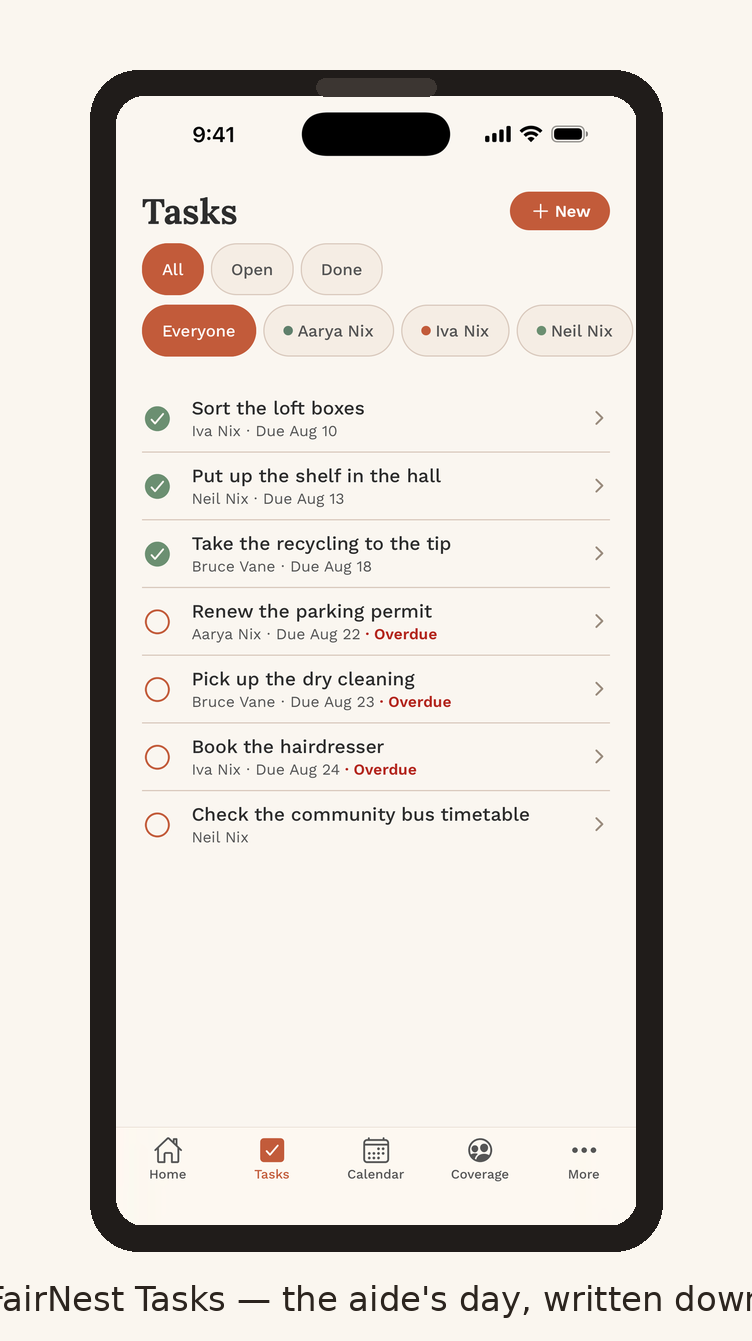
FairNest Tasks — the aide's day, written down so nothing gets missed.
It's my own app, built for families like ours — the ones learning that asking for help isn't giving up, it's how care actually works. You can find it at getfairnest.com.
Hiring a home health aide is one of the bravest things a family can do. It means admitting you can't do it all alone — and then doing the unglamorous work of making sure the person who steps in has what they need to do it well. Write the day down. Show up for the first visit. Keep the loop in one place. Say the hard things early. Do those four things, and the handoff stops being the scary part.
Bottom line: The handoff is the job — not finding the aide. Write the day down before the first visit, show up in person for it, keep every update in one shared place, and say the hard things early. Do those four things and the person stepping in can care for your parent the way you would.
This is general information, not medical advice — talk to your parent's doctor or the home care agency about what's right for your family.
FairNest is my family caregiving app — one shared Nest for tasks, coverage, handoff notes, cost splitting, and med tracking. Find it free on the App Store at https://apple.co/4xRXJuq and on Google Play at https://play.google.com/store/apps/details?id=com.bizvizorllc.fairnest, and follow along at https://www.instagram.com/fairnestapp/.