
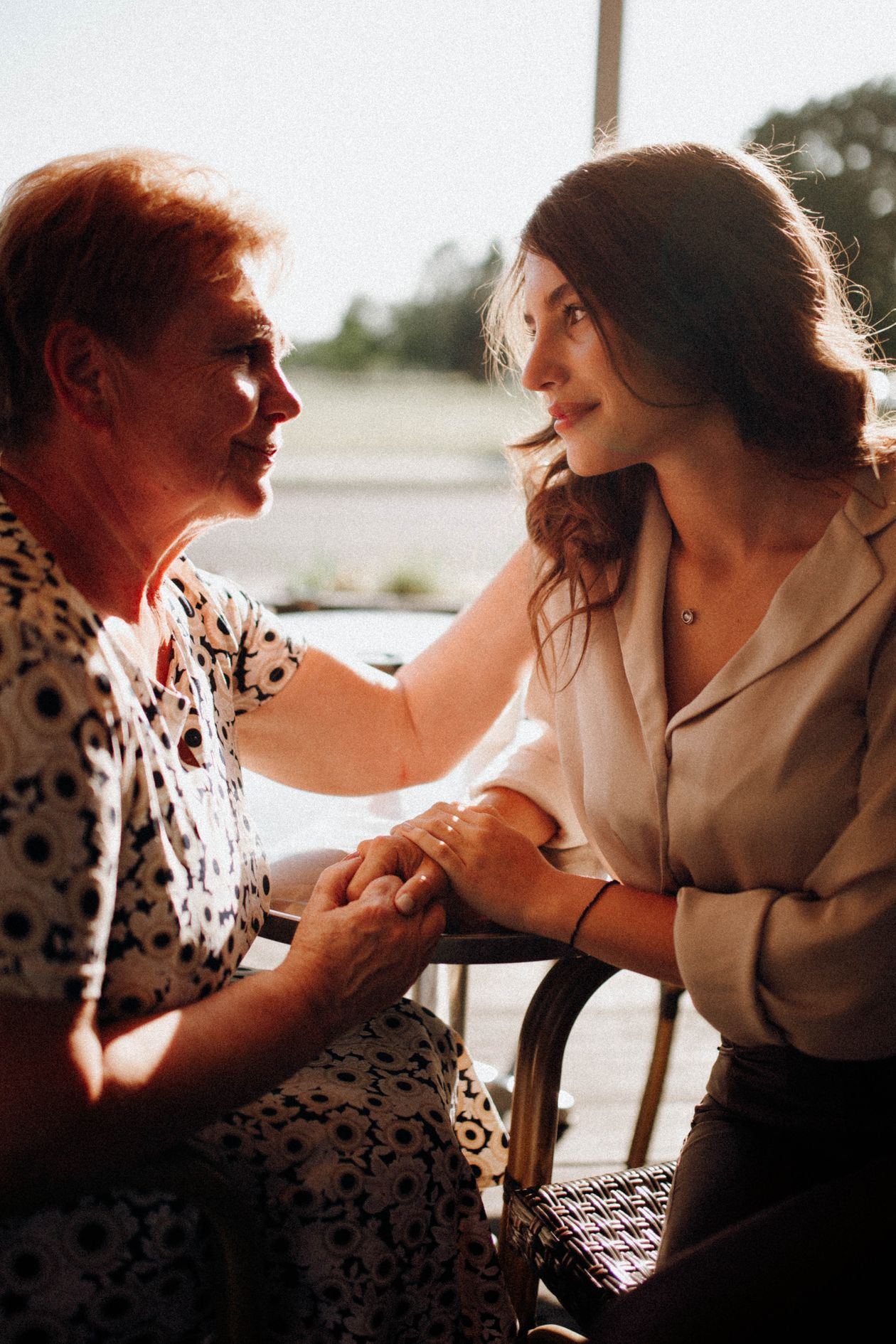
Photo: illustrative — a daughter holding her mom's hands. Stock photo by Danik Prihodko via Pexels.
When a parent with dementia doesn't recognize you, it usually isn't rejection — dementia takes the newest memories first, so your name and recent visits can slip away while older memories and feelings stay. Don't quiz her; introduce yourself warmly every time, lead with touch and a calm voice, bring a familiar photo or song as an anchor, and don't argue with the confusion. Recognition often comes and goes, and even when the name is gone, the feeling usually isn't.
Imagine this: you walk into your mom's living room carrying her favorite muffins, the way you have a hundred times. She looks up from her chair and smiles politely — the smile she gives a kind stranger — and says, "Oh, hello. Can I help you?" For a second, the room tilts. She doesn't know your name. She doesn't know you're her daughter.
If your parent with dementia doesn't recognize you, that moment can hollow you out in a way nothing else in caregiving does. It isn't like a bad day or a forgotten appointment. It feels like losing someone who is still sitting right in front of you. And the worst part is the question that follows you out to the car: what do I do now?
Here's what actually helps, in the moment and after.
Why doesn't my parent with dementia recognize me anymore?
The first thing to understand is what is happening in her brain, because it changes everything about how you respond. Dementia tends to take the newest memories first. Your name, what you do for work, the fact that you visited on Tuesday — those are recent files, and they are often the first to go. The older memories — her childhood kitchen, a song from when she was twenty — can stay clear for years.
That also means recognition often comes and goes. She may not know you at 10 in the morning and then light up when you walk in after lunch. A tired day or a bad night's sleep can make recognition worse for a while. It isn't a straight line down, and it isn't a verdict on your relationship.
And here is the part that matters most: even when the name is gone, the feeling often isn't. She may not be able to say "that's my daughter," but her shoulders can still relax when you sit beside her. She can still reach for your hand. Dementia takes labels before it takes love.
What to Do in the Moment
1. Don't quiz her. "Do you know who I am?" is the question most of us reach for first, and it's the one that helps least. It puts her on the spot, and when she can't answer, she feels the failure — and so do you. Instead, introduce yourself warmly every single time, like it's the most natural thing in the world: "Hi, Mom, it's Sarah. I brought muffins." No test. No pressure. Just an open door.
2. Lead with feeling, not facts. Before you say anything that needs remembering, give her something that needs no memory at all. Sit beside her instead of across from her. Take her hand. Use the calm, unhurried voice she'd recognize in the dark. Tone and touch are older than names — they reach her through a part of the brain dementia touches last.
3. Bring an anchor. A photo from a good day, a song from her era, the smell of the lotion she's used for thirty years — familiar things can do what introductions can't. Keep a small kit by the door: two or three photos, a playlist on your phone. You aren't trying to jog her memory like a quiz show. You're giving her something pleasant to land on.
4. Don't argue with the confusion. If she thinks you're her sister, or a nurse, or a nice neighbor, correcting her rarely helps and often upsets her. A gentle "I'm here to spend time with you" works whether or not she has your name right.
5. Keep it short, and leave on a good note. A calm twenty minutes beats a strained hour. When the visit is going well, that's the time to go — while the feeling is warm. She may forget you came. She is far less likely to forget how the visit felt.
What helps after a visit when your parent didn't recognize you?
First, write down what worked. Did the old hymns calm her? Did the photo album help, or frustrate her? Was she sharper in the morning than the afternoon? These small observations are gold — and they are exactly the kind of thing that gets lost when the next person in the family walks in cold. Keep the notes somewhere your siblings can see them, so nobody has to rediscover the same lessons the hard way.
Second, let yourself grieve. What you felt in that living room has a name — anticipatory grief — and it is real grief, even though your parent is still alive. You are allowed to cry in the car. You are allowed to tell a friend, a sibling, a support group, "She didn't know me today, and it wrecked me."
And one practical note: if recognition drops suddenly — she knew you yesterday and doesn't today — that's worth a call to her doctor. Sudden changes can have causes beyond dementia, and some of them are treatable.
Why I Built FairNest
I built FairNest because caregiving is a team job, and the team falls apart when the notes live in one person's head. In our Nest, handoff notes are where the small, hard-won things go — which songs calm Mom down, that mornings are better than evenings, that she likes her hand held but not her shoulder touched. So when your brother visits on Thursday, he doesn't start from zero.
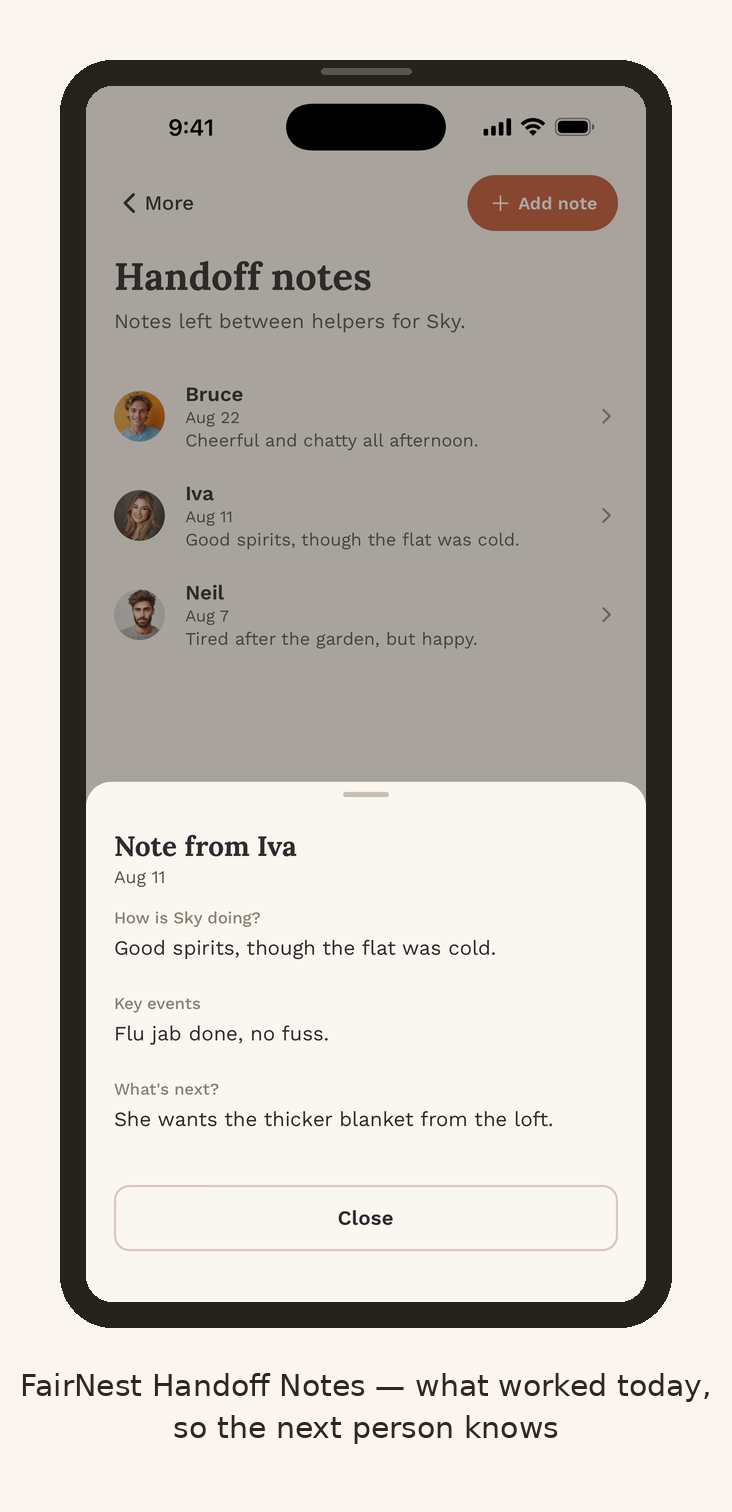
FairNest Handoff Notes — what worked today, so the next person knows.
It's my own app, built for families like ours — the ones learning, visit by visit, how to keep showing up for someone who may not always know our name.
Bottom line
Bottom line: when a parent with dementia doesn't recognize you, it isn't rejection — it's the newest memories going first, and recognition often comes and goes. Introduce yourself warmly, lead with feeling instead of facts, keep visits short and calm, and write down what worked so the next family member doesn't start from zero. She may not always know your name, but she knows how you make her feel — safe, unhurried, loved.
She may not always know who you are. But she knows how you make her feel — safe, unhurried, loved. That is not nothing. On the hardest days, that is everything. Keep going back. The name may come and go, but the connection is still there, waiting for you to sit beside her.
This is general information, not medical advice — if your parent's memory or recognition changes suddenly, talk to their doctor.
FairNest is my family caregiving app — one shared Nest for tasks, coverage, handoff notes, cost splitting, and med tracking. Find it on the App Store at https://apple.co/4xRXJuq and on Google Play at https://play.google.com/store/apps/details?id=com.bizvizorllc.fairnest, and follow along at https://www.instagram.com/fairnestapp/.