
A good family meeting about caregiving has one question on the agenda, a 30–45 minute time limit, a facilitator who isn't the sibling doing the most hands-on care, and a written record of what was decided, who is doing what, and when you'll check back in. Agree on how the decision gets made before you debate the answer — and include your parent in the room whenever you can.
If you're wondering how to have a family meeting about caregiving that actually ends with a plan instead of a pile-up, you're not alone. Most families never sit down and talk about care on purpose. They talk about it in the hallway after a doctor's appointment, in a flurry of midnight texts, or in the car after a rattling visit. Then they wonder why nothing ever gets decided.
Imagine this: say your mom has had a couple of falls, and her doctor has mentioned she shouldn't drive at night anymore. You bring it up with your brother, and before you know it you're relitigating who visited last weekend and something someone said at Thanksgiving three years ago. The driving question never gets answered, nobody feels heard, and nothing changes.
That's not because your family is uniquely bad at this. A caregiving conversation without structure turns into every unresolved feeling at once. A family meeting gives it a container: a time, a topic, and a way to leave with decisions instead of wounds.
What should a family caregiving meeting focus on first?
The fastest way to sink a family meeting is to put "Mom's care" on the agenda. That's not a meeting topic; that's a decade. Pick one decision that needs making in the next two weeks. Driving at night. Who covers the weekend your sister is traveling. Whether to hire help for mornings. One question keeps everyone in the same conversation instead of each person arguing about a different worry.
Send that question ahead of time, in writing, with the meeting time and length. Thirty to forty-five minutes is plenty — longer than that, exhaustion does the deciding. If someone can't make it live, offer a video call, and mean it. The sibling who lives far away shouldn't learn what was decided from a secondhand summary.
Give everyone a job before the meeting starts
Most family meetings have one person doing all the talking and everyone else reacting. Flip that. Ask each person to bring one thing: the latest doctor's note, the cost of the home aide agency, next month's calendar. When everyone arrives with something useful, nobody plays prosecutor or defendant.
It also helps to name a facilitator — ideally not the sibling doing the most hands-on care. That person is already exhausted, and everyone else is already defensive around them. The facilitator's job is simple: keep the conversation on the one question, make sure each person gets heard, and write down what gets decided.
How should a family decide how to make caregiving decisions?
Here's the part families skip, and it's the part that causes the most fights later. Before you debate the answer, agree on how the decision gets made. Does Mom decide, with input from everyone? Do you need everyone to agree, or is a majority enough? Who has the final say on medical questions versus money questions?
This sounds formal, and it is — that's the point. When you agree on the process first, nobody can accuse the outcome of being rigged afterward. And if Mom can participate, she should be in the room, not talked about in the next room. Decisions last longer when the person at the center helped make them.
Write it down before anyone leaves
A decision nobody wrote down is a decision nobody remembers the same way. Before the meeting ends, read back three things out loud: what was decided, who is doing what, and when you'll check back in. Put it in writing the same day — an email, a shared note, whatever your family will actually open — and send it to everyone, including the sibling who couldn't attend.
That record also protects the next meeting. When someone says "but we agreed you'd handle mornings," you can check, kindly, instead of arguing from memory. Memory in stressed families is generous to ourselves and strict with everyone else. Paper is fairer than all of us.
End with a next check-in, not a vague "let's keep talking"
"Let's keep talking about this" is how a family meeting evaporates. Pick a date — two weeks out, a month out — and put it on the calendar before anyone hangs up. A regular check-in turns caregiving from a series of crises into something your family manages together. The first meeting is the hardest; the second is noticeably easier, because everyone already knows its shape.
Why I built FairNest
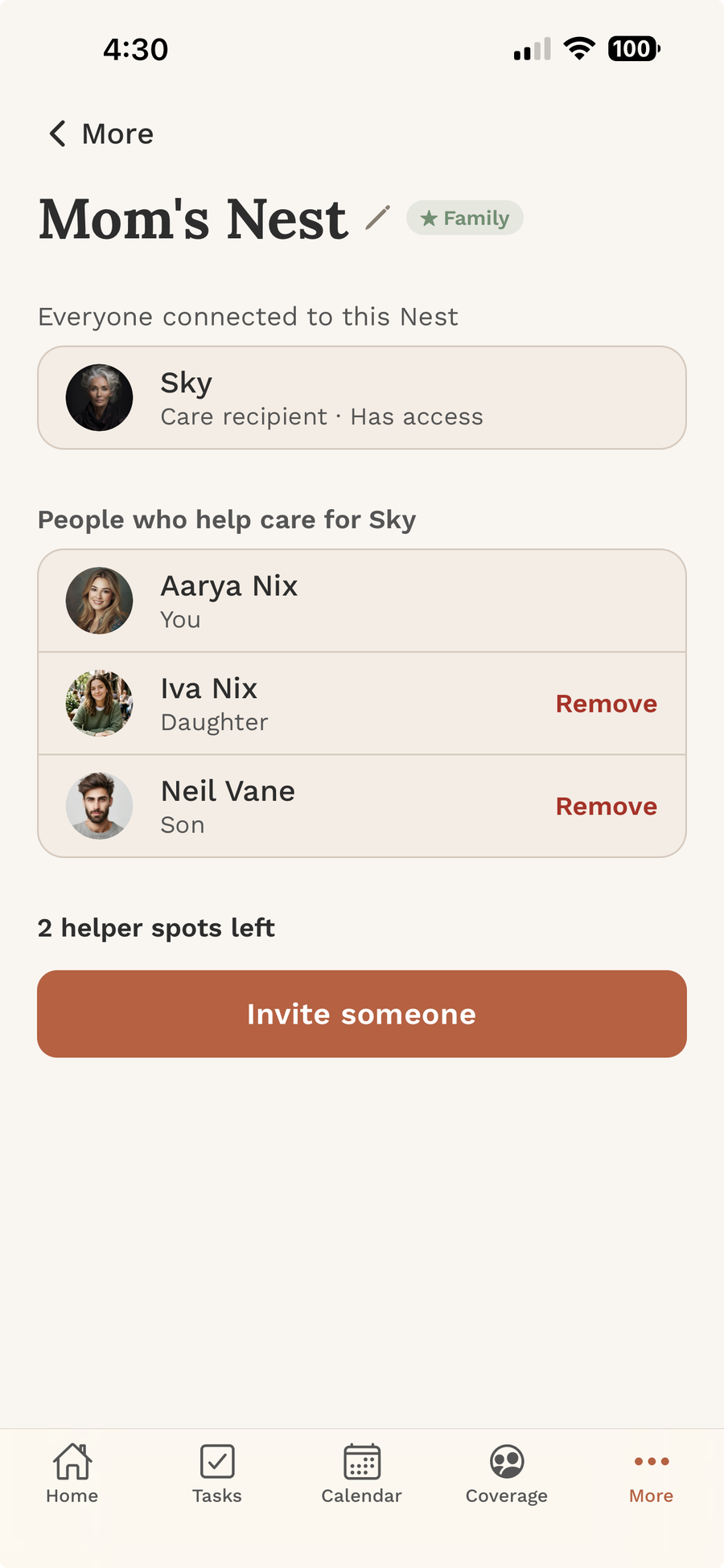
I built FairNest, my own app, because I watched families do all this work and then lose it in a group chat — decisions, schedules, handoff notes scattered across threads nobody could search. FairNest gives a family one shared Nest for tasks, coverage, updates, and handoff notes, so the plan from your meeting lives somewhere everyone can actually find it. You can see it at getfairnest.com, and it's on the App Store here: https://apple.co/4xRXJuq and on Google Play here: https://play.google.com/store/apps/details?id=com.bizvizorllc.fairnest
You don't need an app to have a good family meeting. You need one question, a time limit, and a written record. But once you've done the hard part, it helps enormously to have one place where the plan lives, instead of five phones holding five different versions of it.
Bottom line
Bottom line: a family meeting about caregiving works when it has one question, a time limit, and a written record — and when everyone agrees on how the decision gets made before arguing about the answer. Pick the one question your family keeps circling, send the text, and end with a date for the next check-in. The first meeting is the hardest; the second is noticeably easier.
So here's my suggestion for this week: pick the one question your family keeps circling, and send the text. "Can we talk for 30 minutes on Sunday about Mom's nighttime driving? I'll send a short note beforehand." No preamble, no history lesson, no case to prove. Just a time, a topic, and a promise to write down whatever you decide.
Your family doesn't need to agree on everything. It just needs a way to decide one thing at a time, together — and to remember, next week, what it decided. Follow along on Instagram at https://www.instagram.com/fairnestapp/ for more practical ideas like this one, and give your family the gift of a meeting that ends with a plan instead of a fight.