
Caregiver guilt isn't a sign you're doing something wrong — it's a sign you're doing so much, for so long, that your own tank is empty. You deal with caregiver guilt by making the break a real plan (who covers, what time, what's laid out), by asking whether you'd judge a friend this harshly, and by starting small — two hours, one lunch — and letting the evidence quiet the voice. Rest isn't the opposite of caregiving. It's part of it.
Imagine this: you've finally got a Saturday afternoon free. A friend invites you to lunch. Your parent is settled, safe, and fine for a few hours. And yet, sitting at the table, you can't enjoy a single bite — because a voice in your head keeps saying, "You should be there. What kind of daughter leaves when her mom needs her?" That voice has a name: caregiver guilt.
If that voice sounds familiar, you're not alone — and you're not a bad caregiver for hearing it. Learning how to deal with caregiver guilt is one of the hardest parts of this whole job, because guilt doesn't show up when you're doing something wrong. It shows up precisely when you're doing something right for yourself.
Why do caregivers feel so guilty about taking a break?
Guilt is sneaky because it dresses itself up as love. It tells you that resting means abandoning, that asking for help means failing, that enjoying an afternoon means you don't care enough. None of that is true, but it feels true at 2 p.m. on a Saturday when your phone is in your pocket and your parent is home without you.
Here's the part nobody says out loud: guilt often isn't a signal that you're doing too little. It's a signal that you're doing so much, for so long, that your own tank is empty — and the idea of refilling it feels selfish. Caregivers who feel the most guilt are usually the ones carrying the most. If you didn't care deeply, you wouldn't feel guilty at all.
So instead of trying to eliminate guilt (good luck — it's wired into most of us), try changing your relationship with it. Notice it, name it, and then decide based on facts, not feelings. Is your parent safe right now? Is someone covering? Is this break actually harming anyone? If the honest answers are yes, yes, and no, then the guilt is just noise — loud noise, but noise.
How do I take a break from caregiving without feeling guilty?
1. Make the break a plan, not an escape
Guilt thrives on vagueness. "I'm disappearing for a while" feels irresponsible. "Mom's covered Saturday 1–5 by my brother, her meds are laid out, and I'll check in at 4" feels like a plan — because it is one.
Write the coverage down. Who's on, what time, what they need to know. When the plan is visible and specific, there's nothing left for guilt to argue with. This is the single biggest difference between a break that restores you and a break you spend anxiously checking your phone.
2. Trade guilt for a fair question
When the voice starts up, answer it with a question: would I say this to my best friend? If your friend told you she took one afternoon off after six months of daily caregiving, would you call her selfish? Of course not. You'd probably tell her she waited too long.
Hold yourself to the same standard you'd hold someone you love. That's not lowering the bar — it's finally applying it fairly.
3. Start small and prove it to yourself
If a whole weekend away feels impossible, don't start there. Start with two hours. A walk. A coffee with a friend. A nap with your phone on silent. Then come home and notice: everything was fine. Your parent was fine. The world did not fall apart.
Small, successful breaks are evidence, and evidence is the only thing that quiets guilt long-term. Each one makes the next one easier — not because the guilt disappears, but because you've now got proof it was wrong.
4. Let someone else hold the details while you're gone
The hardest part of stepping away isn't leaving — it's the mental load that follows you out the door. Did someone remember the evening pills? Does my brother know about the new prescription? What if something comes up and nobody knows what to do?
That's exactly why I built FairNest, my own app for family caregiving. It gives your family one shared Nest where tasks, coverage, handoff notes, and med tracking all live in one place — so when you step away, the person covering for you isn't guessing, and you aren't carrying the whole plan in your head while you're supposed to be resting. You can see it at getfairnest.com, and it's on the App Store here: https://apple.co/4xRXJuq and on Google Play here: https://play.google.com/store/apps/details?id=com.bizvizorllc.fairnest
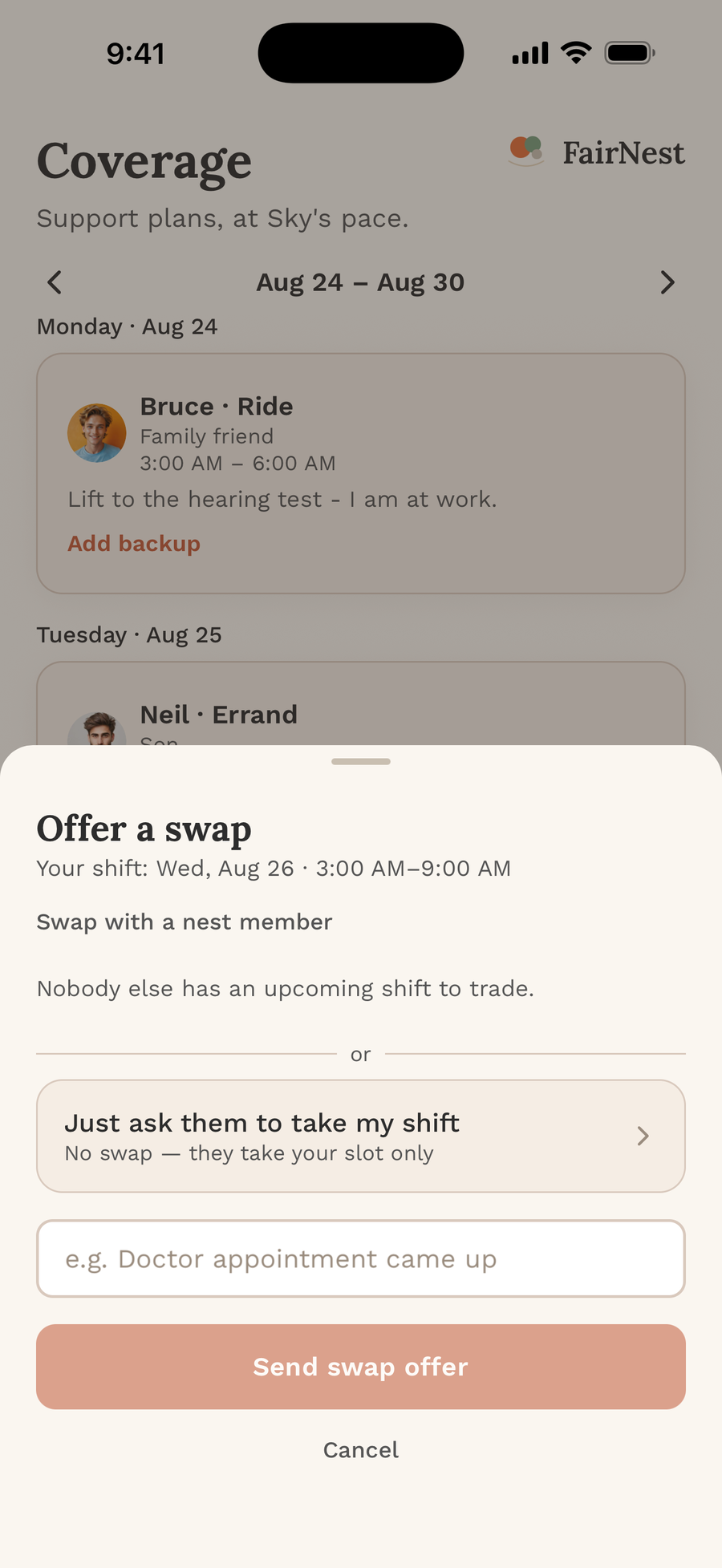
A break only works if you can actually let go for a few hours. A shared plan is what makes letting go possible.
Bottom line
Bottom line: caregiver guilt shows up most in the people carrying the most — it's not proof you're failing, it's proof your tank is empty. A break only restores you when it's a real plan: named coverage, written details, and permission to put the phone down. Your parent doesn't need a caregiver who never rests; they need one who can keep going, patient and steady, for months and years.
The reframe worth keeping
Your parent doesn't need a caregiver who never rests. They need a caregiver who can keep going — patient, steady, and kind — for months and years, not just this week. Rest isn't the opposite of caregiving. It's part of it. The caregivers who last are the ones who figured out how to take a break without apologizing for it.
So the next time guilt pipes up on a Saturday afternoon, try this: thank it for showing you how much you care, and then go enjoy your lunch anyway. The guilt will probably come along for the first few outings. Let it sit in the corner. It doesn't get to order for you.
You can follow along with more of this kind of thinking on Instagram at FairNest — and if today is the day you finally take that break, I hope it's a good one. You've earned it.