
To divide caregiving responsibilities between siblings, list every job for a typical month — visible and invisible — match jobs to each person's distance, time, and skills, give every job one owner, a backup, and a rhythm, and agree on how you'll flag overload and change the split. Fair doesn't always mean identical; it means every job has a name on it and nobody carries the whole load alone.
Imagine a Sunday visit where everyone can see your mom needs more help than she did last year. Your brother says, "We should all pitch in." Your sister nods. You go home and, somehow, you're still the one booking appointments, refilling prescriptions, and checking in every night. If you're searching how to divide caregiving responsibilities between siblings, the gap is rarely love. It's that "pitch in" was never turned into named jobs.
Dividing the work doesn't have to start with a fight about who has done the least. It works better as a planning job: list everything, match jobs to what each person can realistically do, and write down who owns what. Here's a calm way to do it, even if your family has avoided this conversation for a while.
How do we divide caregiving responsibilities between siblings — step by step?
1. Make the full list before you divide anything
Don't start by assigning. Start by naming the work, all of it, for a typical month.
Include the visible jobs — rides, visits, groceries, meals, house checks — and the invisible ones: scheduling appointments, talking to insurance, sorting medications, paying bills, researching help, and being the person your parent calls first. Many families are surprised by the length of the list. That surprise is useful. You're not building a case against anyone; you're showing the size of the job you're asking everyone to share.
Keep the list factual and short. "Call pharmacy when refills are due" is clear. A long history of who forgot what last spring will pull the conversation backward.
2. Match jobs to distance, time, and skills — not guilt
Fair doesn't always mean identical. A sibling who lives ten minutes away may be the natural person for a quick home check. A sibling who lives far away can't do that, but they can own scheduling, insurance calls, online grocery orders, research, or regular phone check-ins, and share costs for help that needs to be local.
Ask each person three honest questions: What can you do every week without burning out? What can you do from where you live? What are you actually good at — paperwork, driving, cooking, staying calm in a medical office?
Write the answers down. A small job done reliably is worth more than a big promise that fades by the second week. And name what nobody in the family can sustainably do. That gap is real information, too — it may be where a neighbor, a cousin, or paid help for a few hours a week belongs.
3. Give every job one owner, a backup, and a rhythm
This is where most family plans quietly fall apart. "We'll all keep an eye on Dad" means no one knows who is checking today.
For each job, write one name first. Not two names sharing it vaguely — one owner. Then add a backup for sick days and work trips, and a rhythm or deadline: every Tuesday, by Friday, twice a month. "One sibling owns the Saturday grocery run, another backs them up, the list goes out Thursday night" is a plan. "We all help with groceries" is a wish.
Do the same for coverage. Who is the first call on weekday evenings? Who covers a weekend when the usual person travels? Your parent benefits, too, because they know who to expect instead of wondering who might show up.
4. Agree how you'll flag overload and change the split
A good split today can be wrong in three months. A job grows, a sibling's work schedule changes, a parent's needs increase. If the only way to reopen the plan is an exhausted blowup, people will wait far too long to say they're drowning.
Set a short monthly check-in — twenty minutes is enough — with one question: what's not working? Agree in advance that saying "I can't keep doing this piece" is information, not failure. Swap a job, shrink it, or bring in outside help before resentment does the talking for you.
Why I built FairNest
I built FairNest, my own app, because I kept seeing this exact pattern: families agree in principle, then the plan lives in one person's head and a scattered group chat. A week later, nobody can find who agreed to what.
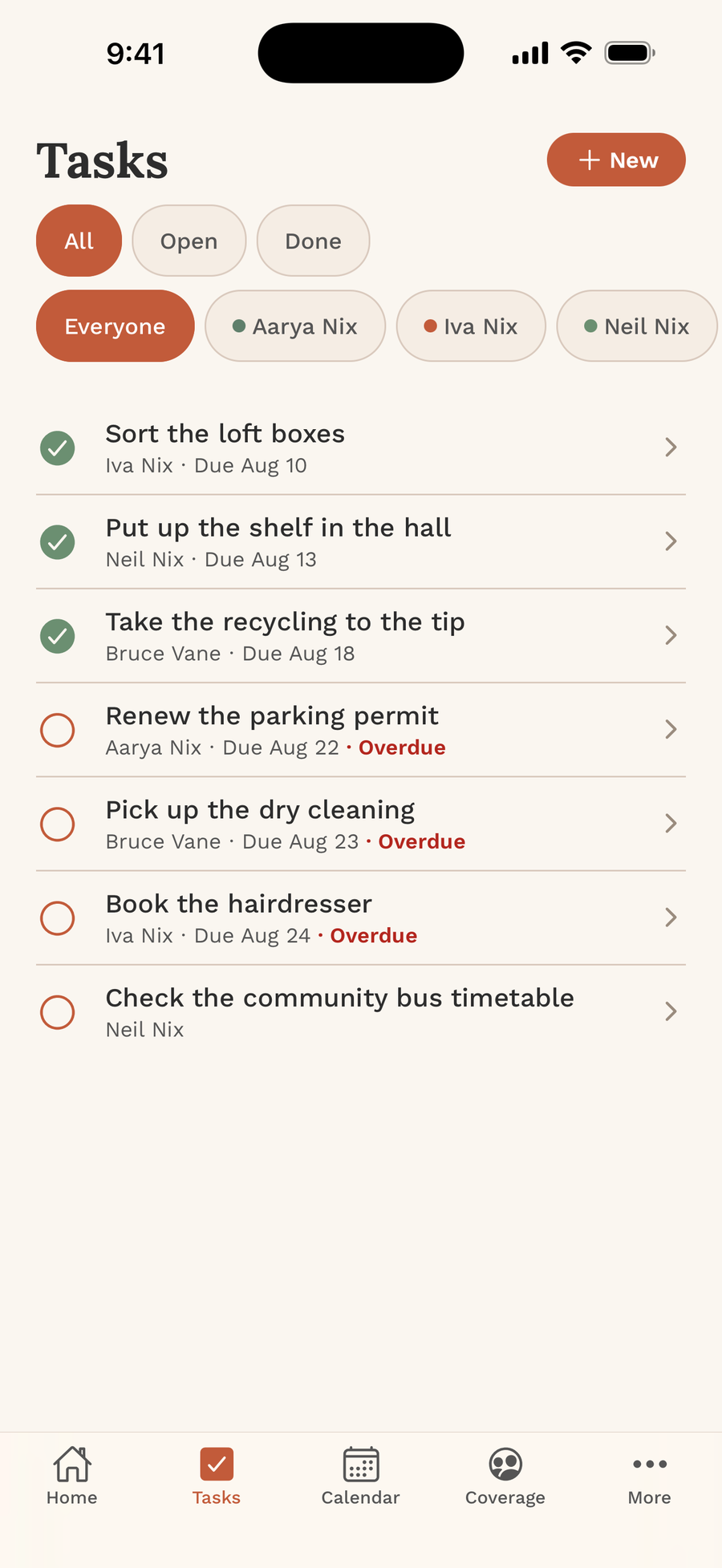
FairNest gives a family one shared Nest for tasks, coverage, updates, and handoff notes, alongside med tracking and cost splitting. The list you made together becomes visible jobs with names on them, so a sibling doesn't have to ask the usual organizer what's needed — they can just look and do their piece. You can see how it works at getfairnest.com.
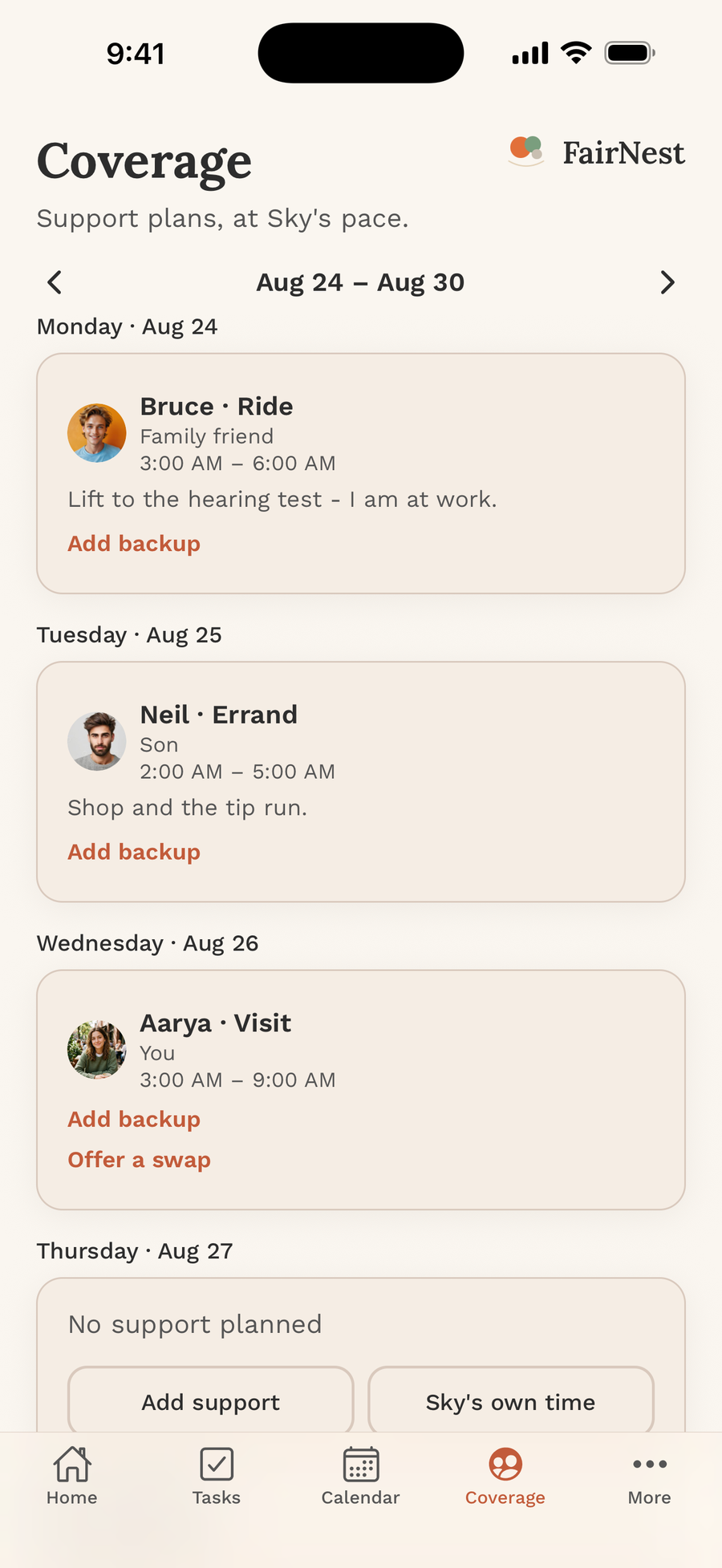
You don't need an app to do any of this. A shared note or a paper chart on the fridge can hold a clear split. The point is that it is written, shared, and reviewed — not remembered differently by three people.
How do I start dividing caregiving without starting a fight?
If your family has been circling this for months, shrink the first step. Don't try to settle fairness forever this weekend. Just make the full list, together, and let each person claim one recurring job they can honestly hold.
That's how a vague "we all pitch in" becomes care your parent can count on — and care no single sibling has to carry alone, quietly, until they break.
Bottom line
Splitting caregiving duties between siblings works when the work is listed, matched to real capacity, and given one owner, a backup, and a rhythm. Clear sibling caregiving roles and responsibilities mean everyone knows who does what caring for an aging parent — and a family caregiving plan your siblings can actually follow is worth more than a perfect one nobody remembers.
FairNest is the family caregiving app I built for exactly this kind of shared planning — one Nest for tasks, coverage, and the updates everyone needs. Download FairNest on the App Store or on Google Play, and follow along on Instagram.