
The signs of caregiver burnout are exhaustion that sleep doesn't fix, irritability over small things, dropping the activities that were yours, ignoring your own health, guilt in both directions, doing everything yourself because explaining feels harder, and daydreaming about a break you can't take. These caregiver burnout symptoms build quietly — if three or more sound familiar, you're not just tired, you're running on empty, and the load itself needs to change, not your attitude.
Imagine you're driving home from your dad's house and you sit in the parked car for ten minutes because walking through your own front door feels like one task too many. Nothing dramatic happened today. No emergency, no bad news. You just feel flat, irritable, and tired in a way sleep doesn't fix. If you're searching for the signs of caregiver burnout, that quiet, heavy feeling is often where it starts — not with a breakdown, but with a slow drain.
Burnout rarely announces itself. Most caregivers don't say "I'm burned out." They say "I'm just tired" for six months straight. Here's how to spot it earlier, and what actually helps.
This isn't medical advice — if you're feeling persistently low, anxious, or unable to sleep, talk to your own doctor about what's right for you.
What are the signs of caregiver burnout most people miss?
Forget the dramatic image of someone collapsing. Real burnout is quieter, and it builds in layers:
1. You're tired after sleeping. You got seven hours and woke up exhausted anyway — the running list never fully powers down.
2. Small things set you off. A pharmacy hold time, a sibling's casual "how's Dad?" text — your reaction is bigger than the moment deserves. Irritability is information: your reserves are gone.
3. You've stopped doing the things that were yours. The walk, the book group, the Saturday coffee. They didn't get cancelled in a big decision — they just quietly stopped happening, one skipped week at a time.
4. You're ignoring your own body. The dentist appointment you keep moving. The headache that's become normal. Caregivers are famous for keeping every one of their parent's appointments and none of their own.
5. You feel guilty in both directions. Guilty with your parent because you should be working or with your kids. Guilty anywhere else because you should be there. Guilt with no exit means you're carrying more than one person sustainably can.
6. You're doing everything because explaining is harder. "It's faster if I just do it" sounds efficient. It's also how one person becomes the only one who knows how anything works — which makes rest impossible later.
7. You daydream about an emergency — yours. If you've ever caught yourself thinking a few days in hospital sounds restful, that's not weakness. That's a flashing light.
If you recognized three or more of these, don't file it under "everyone feels this way." Everyone does feel stretched. Burnout is when stretched becomes your permanent state.
Why won't willpower fix caregiver burnout?
Most burnout advice fails because it treats a load problem like an attitude problem. A bubble bath does not redistribute a single task.
The honest math: if the hours of care your parent needs exceed what one person has — alongside a job, a family, and sleep — no amount of positive thinking closes that gap. The load itself has to change: fewer things resting on you, or more people carrying real pieces of it.
What actually lightens the load when you're burned out?
Make the invisible work visible. Write down everything you did for your parent this week — not just visits, but the refills, the insurance calls, the "just checking in" drives past the house. Most families are stunned by the full list. You can't share work nobody can see — and often you are the one who needs to see it first.
Ask for one specific thing, not "help." "I need help" is easy to agree with and do nothing about. "Can you take Dad's Thursday appointment every week, and own his prescription refills?" is a job someone can say yes to — and keep doing. Small, specific, recurring beats large and vague every time.
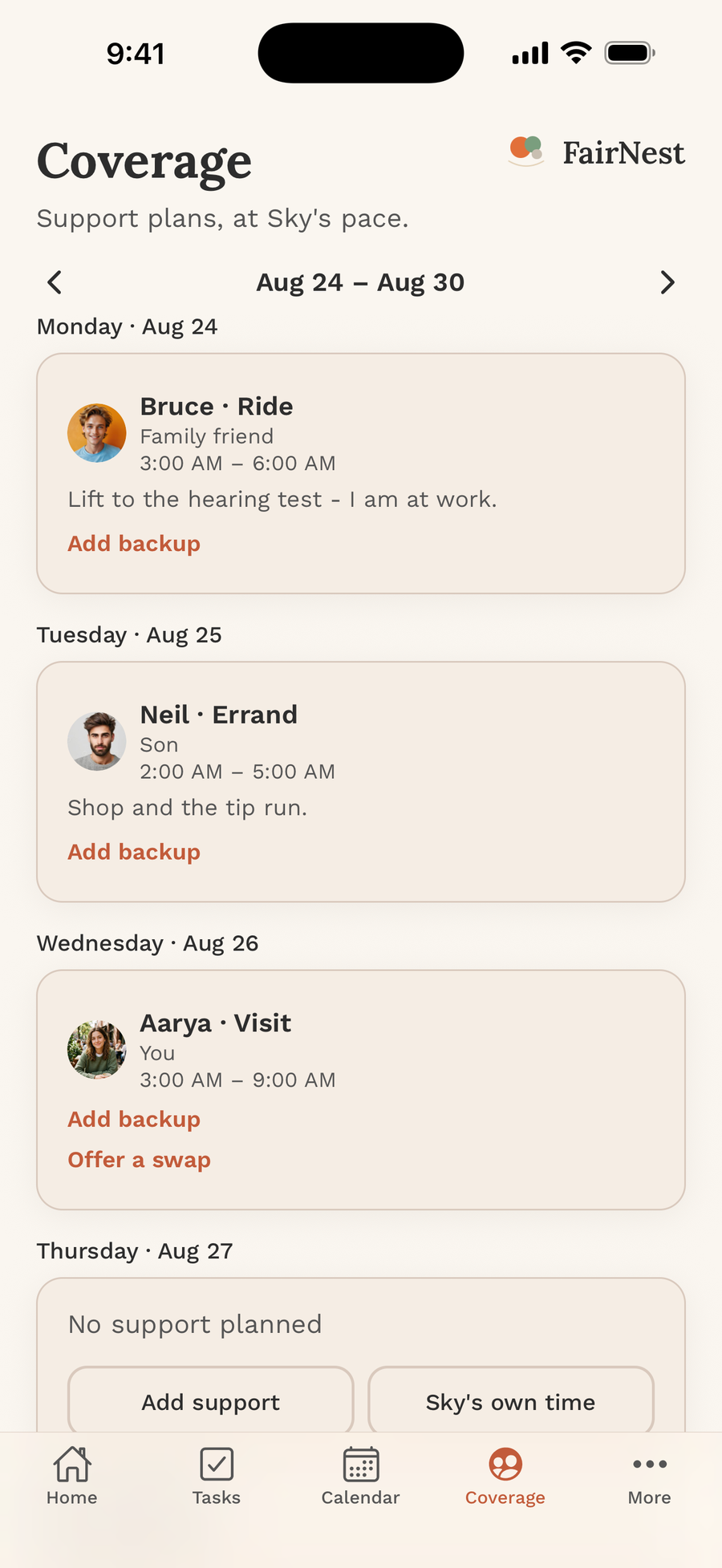
Build in coverage before you desperately need it. Pick one block a week that is yours and defended — an afternoon, an evening, whatever is real. Name who covers it. Put it on the shared calendar where everyone can see it, and treat swapping it like swapping a work shift: it gets traded, not just dropped.
Why I built FairNest
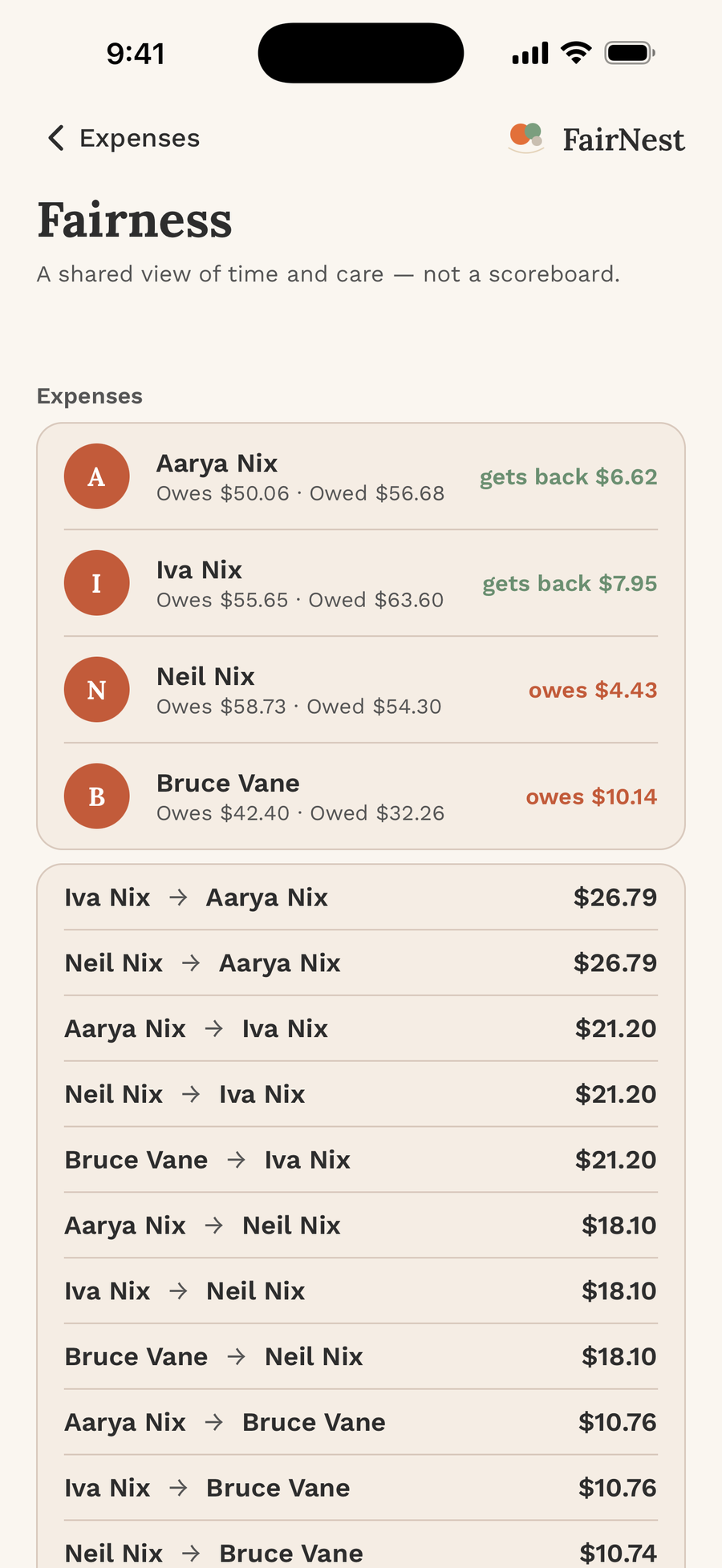
I built FairNest, my own app, because I kept hearing the same story: one sibling quietly becomes the default for everything, and by the time they say "I can't do this anymore," they're already past empty. FairNest gives a family one shared Nest for tasks, coverage, updates, handoff notes, cost splitting, and med tracking — so the full weight of the week is visible to everyone, not just felt by one person. When your sister can see that you've covered the last nine evenings, the conversation about sharing changes. Learn more at getfairnest.com.
You don't have to use an app for this, by the way. A shared note and an honest calendar will do. The tool matters less than the principle: the load has to be seen before it can be shared.
A smaller week is not a smaller love
Doing less for your parent is not caring less about them. A rested, present daughter or son on four days beats a resentful, depleted one on seven — for your parent most of all. They can feel the difference.
Start this week with the list. Pick one item to hand over — completely, not supervised. Then protect one block of time that's yours. That's not self-indulgence. That's how caregiving lasts years instead of months. Staying able to do it is the job.
Bottom line
Caring for an aging parent is exhausting, and emotional exhaustion is a signal, not a failure. If you know what caregiver burnout feels like because you're living it — the flat tiredness, the short fuse, the life quietly narrowing — start with the list, hand off one job for good, and protect one block of time that's yours, even if it's just a few hours of respite care.
FairNest is the app I built for exactly this — one shared place for coverage, tasks, and the real load of the week, so no one person quietly carries it all. Download FairNest on the App Store or on Google Play, and follow along on Instagram.