
To split caregiving expenses fairly, name both contributions — time and money — agree on what counts as a shared expense, pick a split every sibling can explain, and settle up monthly from one shared log. That way the sibling doing the hands-on care isn't also quietly carrying the biggest share of the elder care costs, and family caregiver cost sharing stops being a source of resentment.
Say your brother lives three states away and your sister lives twenty minutes from your dad. Your sister drives to appointments, picks up prescriptions, and sits in waiting rooms. Your brother can't do any of that from where he lives, so he offers to cover more of the bills instead. Nobody disagrees. Then a month of groceries, pharmacy runs, and a plumber's visit goes by, nobody wrote anything down, and you're all quietly googling how to split caregiving expenses fairly — because the current system, whoever happens to be standing there pays, doesn't feel fair to anyone.
The problem usually isn't generosity. It's that your family is trying to split one kind of contribution (money) without ever naming the other one (time). Here's a calmer way to handle both.
How do I split caregiving expenses fairly when one sibling does more of the hands-on care?
One sibling contributes hours: coverage, drives, insurance calls, weekday check-ins. Another contributes dollars: the Saturday aide, the grocery delivery, the home repair that couldn't wait. A third might contribute a mix, or less of both right now because of their own job or kids.
Before you talk percentages, get both contributions on the table, out loud, without scoring them. Try opening with: "Let's make sure nobody is carrying this alone — in time or in money." That turns a tense money talk into a shared fairness problem, and gives the hands-on sibling permission to say the time costs them something too.
Step one: agree on what counts as a shared expense
Write down, together, what counts as shared. For most families that includes groceries for your parent's house, pharmacy and medical supplies, home safety fixes, paid help like an aide or cleaning service, and transport to appointments.
Then agree on what stays personal — gifts, extras one sibling chooses alone, travel that mixes a visit with a vacation. The exact list matters less than having one. Most flare-ups aren't over the big bills everyone expected. They're over a $60 purchase one person assumed was shared and another never agreed to.
What's the fairest way to split elder care costs between siblings?
There's no single right formula, only one your family can explain without resentment. Three approaches work for a lot of families:
Equal split, time acknowledged separately. Split shared dollars evenly, and separately make sure the hands-on sibling gets real breaks — coverage swaps, a paid aide for a weekend, first claim on holidays off. This works when incomes are similar and the time gap is handled openly.
Split by capacity. If incomes are very different, split by a proportion everyone agrees feels workable — for example, one sibling covers 50 percent, the others 25 percent each. Naming the reason ("this matches what each of us can do right now") keeps the higher payer from feeling punished for earning more.
Money offsets time. If one sibling does significantly more hands-on care and can't reduce it, the others cover a larger share of the dollars, or pay for help that gives that sibling hours back. The point isn't to price a son's or daughter's time. It's to make sure the person giving the time isn't also quietly giving the most money.
Whichever you choose, write it down and set a date to revisit it — three months is a good rhythm. Care needs change, and an agreement that can be revisited doesn't have to be perfect today.
This isn't financial advice — talk to a qualified professional about what applies to your family's situation, especially for anything involving your parent's accounts, benefits, or taxes.
How do I track shared care expenses so nobody keeps score?
Even the best agreement falls apart if nobody records the spending. Memory is generous to ourselves and fuzzy about everyone else, and three months of "I think I covered most of that" helps nobody.
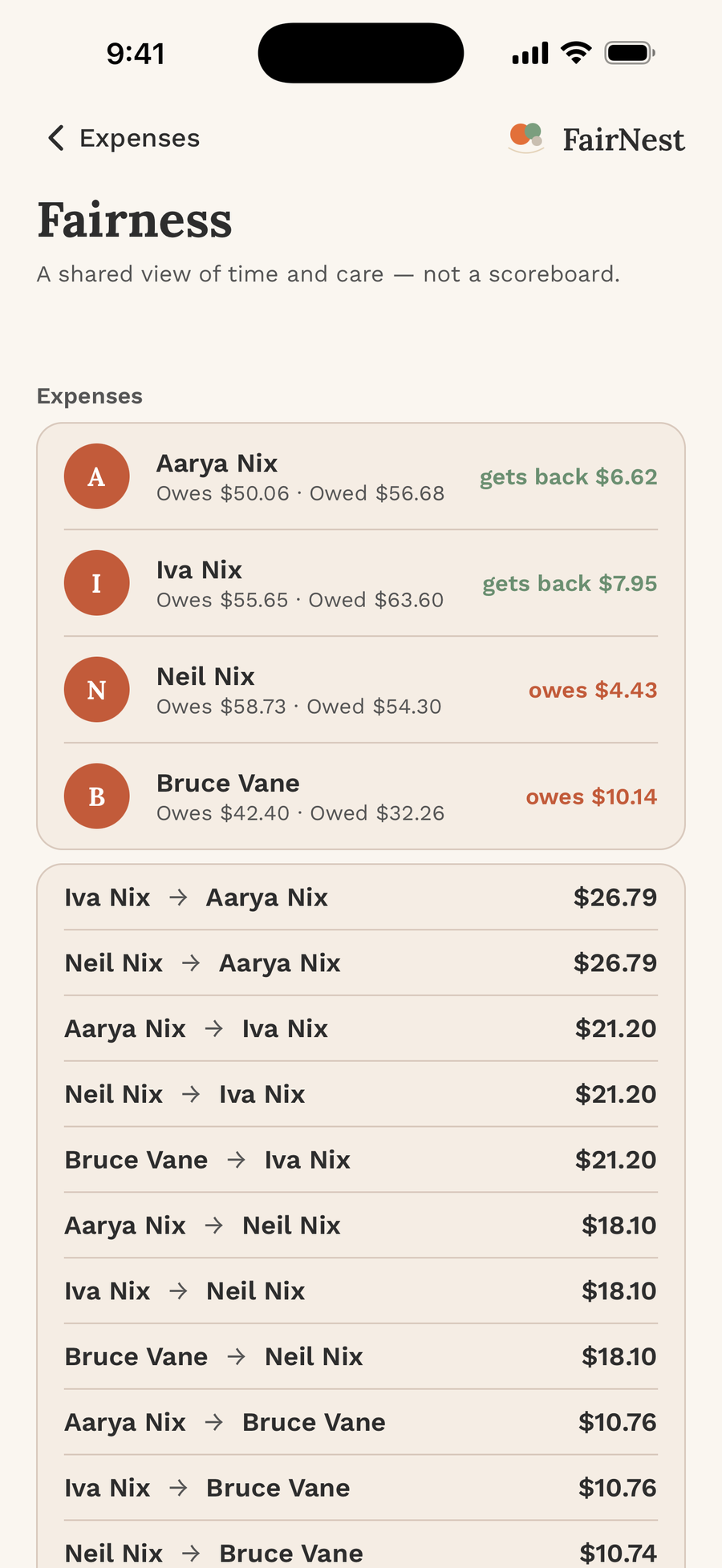
Keep one shared log. Every shared expense goes in when it happens — amount, what it was for, who paid — in one place every sibling can see and add to. Then settle up once a month in fifteen minutes: check the total, check who paid what, and even it out against your agreed split. Monthly is frequent enough that no balance grows into a grievance, and brief enough that people actually show up.
Why I built FairNest
I built FairNest, my own app, because I kept watching this pattern: the sibling closest to a parent became the default payer, the record lived in scattered receipts and chat messages, and by the time anyone raised it, the conversation was about months of feeling unseen — not the money itself.
In FairNest, a family shares one Nest for tasks, coverage, updates, handoff notes, med tracking, and cost splitting. Shared expenses sit alongside the coverage calendar, so time and money are visible side by side instead of living in two separate arguments. Your parent can be in the Nest too and see what's going on. You can learn more at getfairnest.com.
A fair split is a kindness, not an accounting exercise
You don't need a perfect formula. You need the contributions named, a short list of what's shared, a split everyone can explain, and a monthly habit of settling up before small imbalances turn into big feelings.
Start this week with the easiest version: one short conversation, one shared list, one date to check in again. The goal was never to make caregiving feel like a business. It's to make sure love for a parent doesn't quietly turn into a burden one sibling carries alone.
Bottom line
Splitting caregiving expenses fairly isn't about finding a perfect formula — it's about naming time and money together, agreeing on what's shared, and settling up monthly from one list. When the contributions are visible, the question of who pays for a parent's care stops being a quiet resentment and becomes a plan everyone can explain — and care coordination gets easier, not harder.
FairNest is the family caregiving app I built for exactly this — one shared place for costs, tasks, coverage, and updates, so fairness doesn't depend on anyone's memory. Download FairNest on the App Store or on Google Play, and follow along on our Instagram.