
A home safety checklist for elderly parents takes about ninety minutes: check the stairs and entryway, add grab bars and non-slip mats in the bathroom, move daily items down to counter height, and light the 2 a.m. route with motion-sensor nightlights. Most of the fixes cost under a hundred dollars and buy years of safer independence at home — and the walkthrough itself is free.
Picture this: you're visiting your dad's house — the one he's lived in for thirty years — and you watch him carry the laundry basket up the basement stairs. One step at a time, both hands on the railing. When did the stairs get so steep? They didn't. He just got a little slower, and the house didn't get any safer to match.
Here's the thing nobody tells you about aging in place: most parents will insist — correctly — that they want to stay in their home. But most of their homes were built for people who are 45, not 85. The mismatch creeps up slowly until one fall reorganizes everyone's life. Falls are the leading cause of injury for adults over 65, and most happen at home — the bathroom, the stairs, the dark hallway to the bathroom at 2 a.m.
The good news: you don't need a contractor or a big budget. You need ninety minutes, a notepad, and a willingness to see the house with fresh eyes — while they're out, or with them if they're open to it. You're not looking for reasons to move them. You're looking for the cheap, fast fixes that buy years of safe independence.
This isn't medical advice — an occupational therapist can do a proper fall-risk assessment. This is the family-level first pass, the stuff anyone can spot.
What should I check first in a home safety walkthrough?
Start where every visit starts: the front door. Can you get from the car to the door without a curb that could trip a shuffle-step? Is the path lit for an evening arrival? Then the stairs.
Handrails should run on both sides, firmly anchored, at a height your parent can actually grip. A wobbly decorative railing is worse than none — it invites trust it can't hold. Check that stair treads aren't lifting, and stand at the top at dusk: is there good light at both ends? The most common stair injuries happen in dim light with hands full — exactly how your dad carries the laundry.
Why is the bathroom the most dangerous room for seniors?
If you fix nothing else, fix the bathroom. Wet tile, hard edges, and a low toilet make this the most dangerous room in the house.
The highest-value item: grab bars mounted into studs — not suction-cup ones, which give way exactly when needed. One by the toilet, one or two in the shower. A raised toilet seat eases one of the hardest daily movements; a shower bench removes the most dangerous thirty seconds of the day. Non-slip mats go inside the tub, and keep the water heater at 120°F max — older skin burns faster than you'd think.
The kitchen
Kitchens get less forgiving with age. What do they reach for daily? Anything stored above shoulder height is an invitation to climb on a chair — move daily items to counter height. Check the fire extinguisher's gauge (most are expired) and swap in fresh batteries for the smoke and carbon monoxide detectors.
Glance in the fridge. Expired food is a quiet signal about memory or vision — not a crisis, but information the whole family should share, not just whoever opened the fridge.
Light, floors, and the 2 a.m. route
Now walk the route they walk at night: bedroom to bathroom to kitchen, lights off first, then flipping switches one by one. Where are the dark spots? Plug-in motion-sensor nightlights cost a few dollars each and may be the single best fall-prevention purchase in existence.
Then look down. Loose rugs are ankle-breakers; anchor them with non-slip pads or remove them. Coil or tape down cords that cross walkways, and move floor-level obstacles into the clear: the pet bowl in the hallway, the ottoman in the walking lane.
The takeaways
1. See the house as it is, not as it was. The walkthrough breaks the "it's always been like this" spell. Bring a sibling — you'll each notice different things. Write everything down; small stuff is most of it.
2. Fix the cheap wins first. Nightlights, rug pads, a mounted grab bar, a shower chair — roughly a hundred dollars and an afternoon for the fixes that prevent the most common falls. The expensive interventions are decisions for later; the cheap ones are decisions for Saturday.
3. Don't ambush your parent. "Dad, we need to talk about your house" triggers a defensive shutdown faster than almost anything. Frame it as a project, not a verdict: "We're doing a safety sweep of everyone's house — mine's next." Ask before fixing: dignity is part of safety. A parent who feels steamrolled stops cooperating next time.
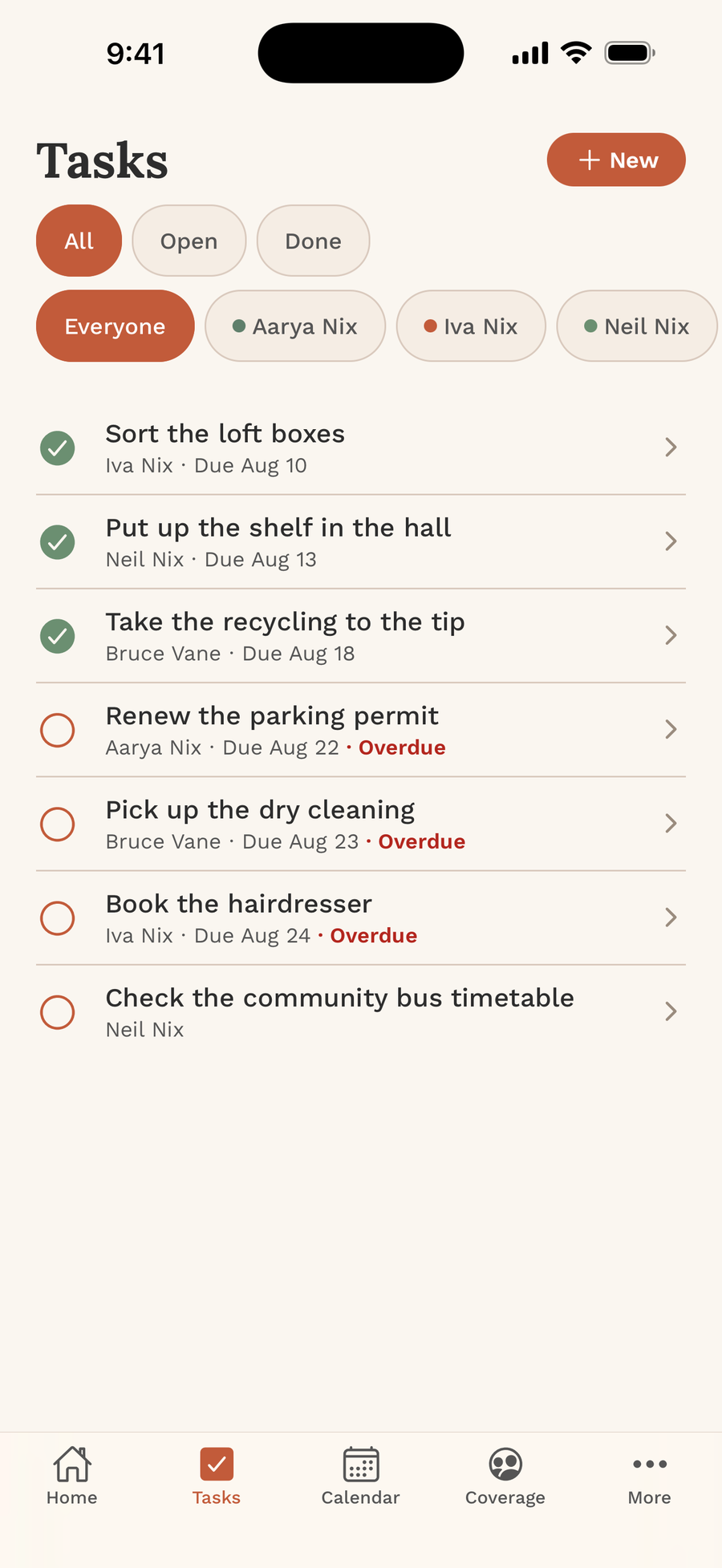
4. Put the list somewhere the whole family can see. If it lives in one person's head, half of it won't happen. This is exactly why I built FairNest — my own app, for my own family's version of this problem. Our shared Nest is where the fix-it list lives as tasks and where coverage for the grab-bar weekend gets assigned. If your family's list is a group chat and good intentions, take a look at getfairnest.com.
5. Re-walk every six to twelve months. Aging in place is maintenance. The house that was fine last spring might not be fine after a quieter winter. Put it on the calendar the way you'd service a furnace — routinely, without drama.
Bottom line
Bottom line: most falls at home are preventable with cheap, fast fixes — grab bars in the bathroom, nightlights on the 2 a.m. route, rugs anchored and cords cleared. Ninety minutes this weekend, a list the whole family can see, and a re-walk every six to twelve months will keep your parent safer in the home they love.
The honest close
The walkthrough was never about proving your parent should move. It's about closing the gap between the house they have and the house they need — one grab bar and one nightlight at a time. Ninety minutes buys them independence, and buys you something money can't: not lying awake wondering about those stairs.
FairNest is the family caregiving app I built for moments like these — a shared Nest for tasks, coverage, and everything the group chat keeps losing. Download it on the App Store or on Google Play. We share caregiving tips daily on Instagram.