
Caregiver burnout usually shows up in your body before your emotions — a clenched jaw, thin sleep, a patience that's suddenly a frayed rope. Catching those early caregiver burnout signs while they're still small is how you stop a slow slide into exhaustion. The fix isn't a spa weekend you'll never take; it's a ten-second nightly check-in, one concrete ask for help, and one protected thing that isn't caregiving.
It might hit you in the kitchen at 9:47 p.m. Your parent is finally asleep, and you realize your jaw aches — you've been clenching it for hours and only just noticed. Or it arrives smaller and meaner: you snap at your parent over the TV volume, then sit in your car feeling like the worst person on earth.
Nobody warns caregivers that burnout doesn't knock. It moves in — one clenched jaw and one skipped lunch at a time — until the person who gives all the care has nothing left to give it from.
Here's the thing nobody says plainly enough: caregiver burnout doesn't usually start in your emotions. It starts in your body. Long before you feel "burned out," your shoulders are up around your ears, your sleep is thin, your patience is a frayed rope. Learn to read those early signals and you can catch the slide while there's still time to do something about it.
1. What are the early signs of caregiver burnout?
Burnout in caregivers tends to announce itself physically before it shows up emotionally. Headaches that weren't there last year. A back that seizes up by Thursday. Stomach trouble. Catching every cold that goes around. The 2 a.m. worry circuit — replaying medication lists and tomorrow's errands while the clock creeps toward morning.
Try a ten-second nightly check-in: jaw, shoulders, breath. Clenching? Shoulders up? Breathing shallow? When two or three of those answers stay "yes" for days running, that's data — not weakness, data. Your body is filing an incident report. Read it.
2. How do I rest when caregiving never stops?
Caregivers tend to treat rest like dessert — something you earn after the real work is done. But the real work is never done. There is always another appointment, another refill, another load of laundry that smells like someone else's medicine.
Flip the model: rest is maintenance. You don't wait for the engine to seize before changing the oil. And you don't need a spa weekend you will never take — twenty minutes counts. A walk around the block. Sitting in your car with the engine off and a song you like. Schedule one non-negotiable pause the way you'd schedule a doctor's appointment for your parent. If you go down, the whole care arrangement goes down with you.
3. Ask for specific help, not "help"
"I need help" is the hardest sentence a caregiver says — and the least effective one. It's so vague that people respond with "just let me know!" and then everyone goes back to their lives.
The fix is to make the ask as concrete as a calendar invite: one specific task, one person, one deadline. "Can you sit with Dad from 2 to 5 on Saturday so I can get my teeth cleaned?" People say yes to concrete asks at a rate that surprises most caregivers — most of the people around you want to help, they just don't know what "help" means.
It also helps to get the whole invisible list out of your head and somewhere everyone can see. Half of caregiver exhaustion isn't the tasks themselves — it's the remembering. The low-grade hum of "am I forgetting something?" that runs all night. When the tasks, the coverage, and who's doing what are visible to the whole family, asking for help stops being a negotiation and becomes a calendar entry.
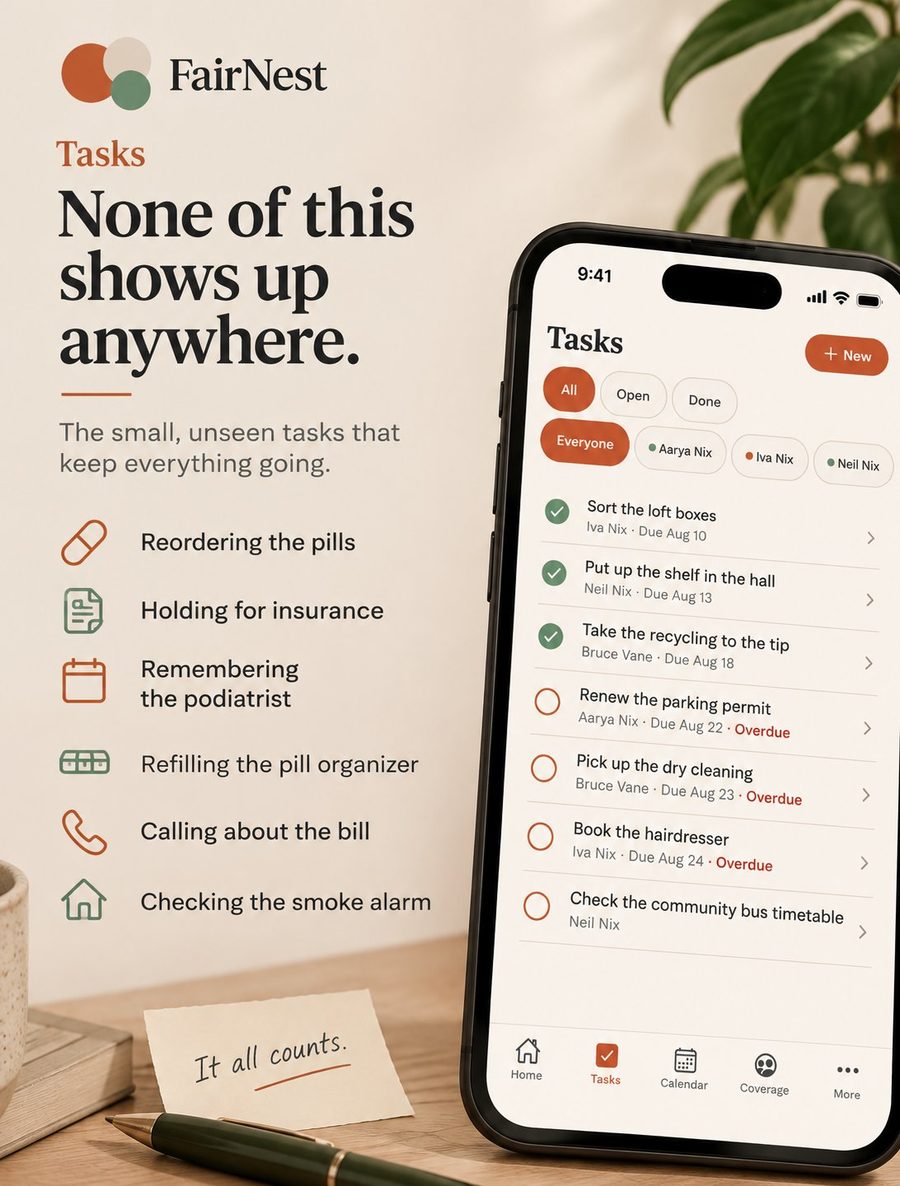
That's a big part of why I built FairNest — my own app, born from my own family's version of this exact problem. Our shared Nest holds the tasks, the coverage schedule, the handoff notes, all in one place the whole family can see. Nobody has to be the family's only memory anymore, and "can someone cover Thursday?" stops being a group-chat negotiation and becomes a simple swap. If you're curious, it's at getfairnest.com.
4. Protect one thing that isn't caregiving
Burnout eats identity first. You stop being a person with hobbies and become a person with a medication schedule. The antidote isn't dramatic — it's deliberate: protect one thing that has nothing to do with caregiving. A weekly walk with a friend. A garden bed. A route you run.
This isn't selfishness; it's load-bearing structure. The version of you that existed before caregiving is the version that makes you good at caregiving. When that person disappears, patience disappears right behind them. Name the one thing, put it on the calendar, and defend it like it's a medical appointment — because it is one.
5. Line up support before you're desperate
Respite care booked while you're still choosing is a gift. Booked after you've cried in a parking lot, it's triage. Same service, completely different experience. The pattern repeats everywhere: the caregiver support group you join before the breaking point, the backup coverage you arrange before flu season.
This isn't medical advice — if exhaustion is affecting your health, talk to your doctor. But the general truth holds: the caregivers who still like their families at the end of a hard year are almost never the ones who powered through alone. They're the ones who built the scaffolding early, while they still had the energy to build.
Bottom line
Bottom line: caregiver burnout rarely announces itself as a feeling — it shows up as a clenched jaw, thin sleep, and a patience that frays by noon. Notice those early signs, ask one person for one concrete thing, and protect one small piece of your life that isn't caregiving. Rest is maintenance, not a reward you earn after the work is done.
The honest close
If you're reading this with your jaw clenched and your shoulders up — unclench, drop them, breathe. Then pick one thing from this list. Not five. One. The nightly ten-second check-in. One concrete ask to one person. One thing on the calendar that is only for you. The best caregivers aren't the ones who never get tired — they're the ones who notice the tiredness early and do something kind about it.
Taking care of someone you love shouldn't mean disappearing yourself. FairNest — the family caregiving app I built for moments like these — is free to try: download it on the App Store or on Google Play. And if a post like this helped, we share more over at our Instagram.