
The short answer: stop being the family bank by accident — log every care expense in one shared ledger the second you pay, agree on a split that's fair rather than just equal, and settle up on a fixed monthly rhythm. The silence around money is what turns small receipts into sibling resentment.
It never starts as a decision. It starts as a Tuesday.
You're at the pharmacy picking up Dad's refills and the card machine blinks at you: $41.60. You pay it. Of course you pay it — the alternative is standing there doing mental math about whose turn it is while the line grows behind you. You'll text the group chat later. You'll mention it. You don't.
Thursday, the handyman installs the grab bars: $180. You're there, so you write the check. Saturday, Mom's incontinence supplies run out and the delivery can arrive tomorrow: $54.22. Tap, done.
Three months later your notes app looks like a ransom ledger — "mom parking $12," "dad labs $35 copay," "cleaner for mom's house $90 (split?)" — and you've got a feeling you can't quite name. It's not really about the money. It's the silence around it. Nobody asked you to front the family's care costs. Nobody said thanks, either.
I hear some version of this story from caregiving families constantly — one sibling quietly learning how to split aging parent care costs with siblings after already floating them for months. The details change — the amounts, the siblings, the group chat where the receipt photo sank without a trace — but the shape is always the same. Without ever applying for the job, one person becomes the family bank.
Why does one sibling end up paying for everything?
Two forces, and they compound. First, proximity: the sibling who's nearest pays first, because they're the one standing at the counter. The sibling two time zones away assumes someone is keeping track. Second, awkwardness: money is already the hardest thing for families to talk about, and aging-parent money — tangled up with guilt, gratitude, old birth-order dynamics — is the hardest version of that conversation.
So everyone politely agrees not to mention it, which is the same as agreeing that one person carries it.
And here's the part nobody says out loud: the real cost isn't the $41.60. It's what the silence does to siblings. Resentment is the quietest relationship killer in caregiving. It doesn't arrive as a fight — it arrives as a slightly colder tone on Sunday calls, a mental tally you keep while pretending you're not. I've watched more sibling relationships strain over unspoken money than over almost anything else.
The good news: this is a systems problem, not a character problem. Nobody's being greedy. There's just no ledger. Here's how to build one.
1. Name the job nobody applied for
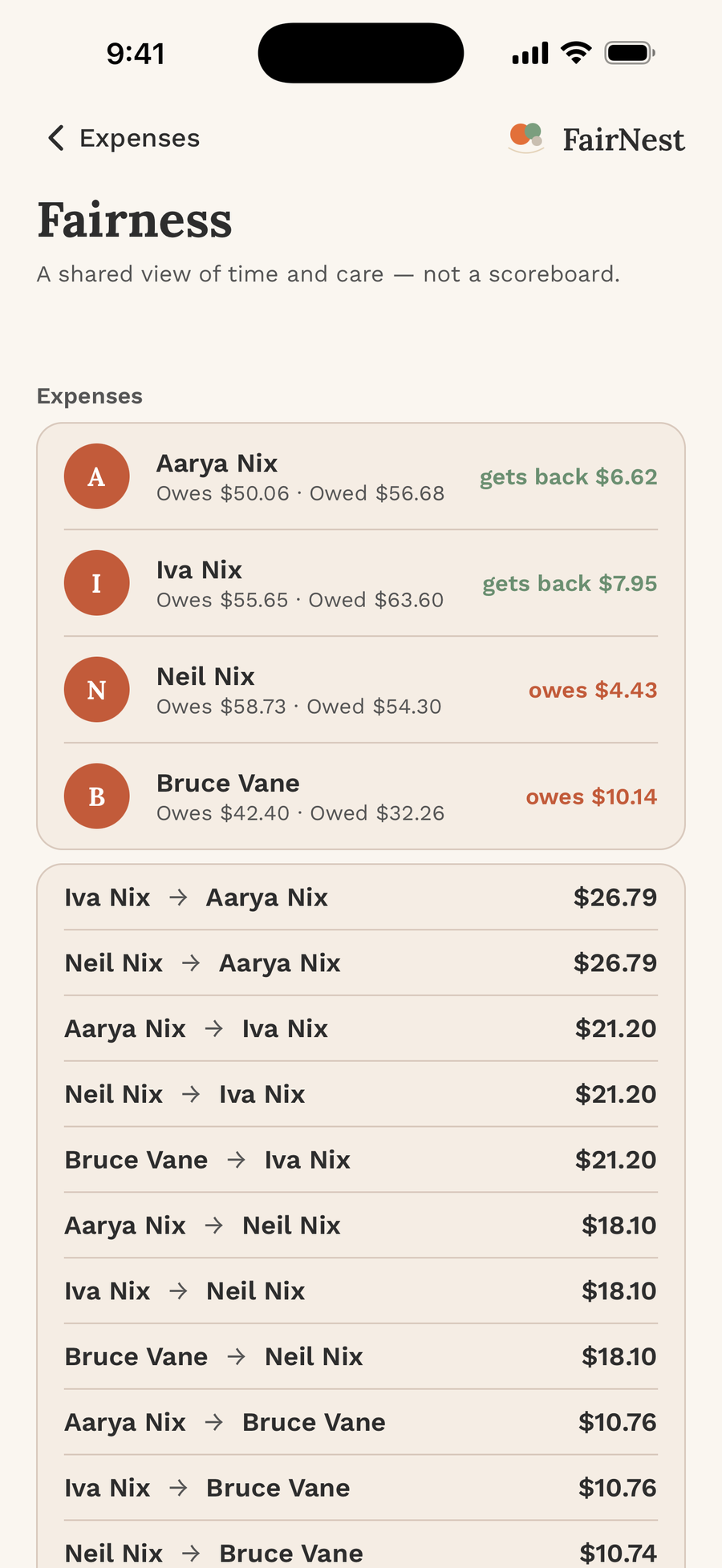
The accidental banker exists because the role was never assigned. So assign it — or better, eliminate it. One shared ledger, visible to the whole family, where every care expense gets logged with a date and a who. The moment costs go from "I think Sarah paid for that" to "here it is, itemized," the fog lifts. Nobody has to ask awkward questions because nobody has to wonder.
2. Log it the second you pay
Thirty seconds, tops: snap the receipt, note what it was for, done. If logging takes longer than paying, you won't do it, and the shoebox (or the notes app) starts filling up again. The best system is the one you'll actually use at a pharmacy counter at 6 p.m. on a Tuesday.
3. How often should siblings settle up care expenses?
"Somebody remind me and I'll Venmo you" is how $2,000 quietly becomes $6,000. Pick a day — the first Sunday of the month — and settle everything then. A fixed rhythm does two things: it keeps balances small enough that nobody panics, and it removes the need for anyone to chase anyone. The calendar does the chasing.
4. Split by fairness, not down the middle
Equal isn't always fair, and this is the conversation that unlocks everything. The sibling who cut back to part-time to drive Mom to appointments is already paying in a currency that never gets reimbursed. The sibling earning half as much shouldn't carry the same share. Talk about it once, write the split down somewhere everyone can see, and stop renegotiating every single invoice. A split you agreed on in daylight survives the 2 a.m. ER visit; a split you never discussed won't.
5. Have the money talk with your parent while you still can
This is the one everyone postpones until a crisis makes it urgent. You don't need their account balances today — you need the door open. Where are the accounts? Is there a power of attorney? What would they want if they couldn't manage things themselves? A calm fifteen-minute conversation now is worth a hundred panicked ones later.
(This isn't financial advice — for the big decisions, talk to a financial professional or an elder-law attorney.)
Why I built FairNest
I built FairNest — my own app — because I watched families drown in the logistics of care, and money is the soggiest part of it. The shared Nest gives the whole family one place for tasks, coverage, and handoff notes, and yes, a cost ledger with fairness splits, so nobody has to be the accidental banker keeping score in a notes app at midnight. If your family's ready to make the invisible visible, FairNest is built for exactly this. You can find it on the App Store here: https://apple.co/4xRXJuq and on Google Play here: https://play.google.com/store/apps/details?id=com.bizvizorllc.fairnest
Bottom line
Bottom line: nobody applies to be the family banker — proximity and awkwardness appoint you. One shared ledger, one fair split agreed in daylight, one monthly settle-up: that's how you stop fronting the family's care costs in silence.
Nobody keeps the family banker's hours because they want the job. You do it because you were there, and someone had to. The least the family can do — the least you can do for yourself — is make it visible: one ledger, one monthly rhythm, one honest conversation about what's fair. Future you, the one without the ransom ledger in the notes app, will be grateful.
I share more of these real-life caregiving money stories over on Instagram at https://www.instagram.com/fairnestapp/ — come say hi.