
The short answer: distance doesn't disqualify you from caregiving — it changes your job. Claim a lane you can own from anywhere (paperwork, research, scheduling, money admin), keep one shared source of truth so you stop flying blind, make your presence predictable with standing rhythms, and when you visit, arrive as a teammate, not a guest.
It's 10:47 p.m. You're three time zones away from your dad, and your phone keeps buzzing — forty unread messages in the family group chat. The appointment got moved. The pharmacy didn't refill. Your sister, the one who lives fifteen minutes from him, has sent three long messages in a row, and you can feel the exhaustion through the screen.
You read everything. You feel the knot in your stomach. You type "let me know how I can help!" — and then you delete it, because you already know how it reads on her end. She's the one driving to every appointment, and you're the one typing from the couch.
If you're the far-away sibling, you know this guilt well. Distance doesn't disqualify you from caregiving, and learning how to care for aging parents from far away starts with one shift: it just changes your job description. Here's how to actually do the job.
1. What should a long-distance sibling say instead of "let me know how I can help"?
It's well-meant, but it hands your already-overloaded sibling another task: the task of figuring out your task. Nobody has energy for that, and nothing ever happens afterward — which is exactly why the phrase breeds resentment on both sides.
Instead, claim a lane. Take the parts of caregiving that don't require a body in the room:
- Paperwork and phone calls. Insurance claims, pharmacy refills by phone, billing disputes — these eat hours, and they can be done from anywhere.
- Research. Finding a good home aide, comparing therapy options, reading reviews of care communities. Slow, grinding work the hands-on sibling never has time for.
- Scheduling. Doctor's appointments, prescription refills, the ride to the appointment. Be the family calendar keeper.
- The money admin. Tracking what's been spent, keeping receipts in one place, making sure everyone can see the same numbers.
Don't ask which of these to take. Just take one and say: "I'm handling all of Dad's prescription refills from now on." Specificity is a gift.
2. How can a far-away sibling stay in the loop on a parent's care?
The far-away sibling's real disadvantage isn't distance — it's blindness. Your sister knows Dad slept badly last night. You know none of it. So every conversation becomes an interrogation ("How's Dad doing? No, really, how is he?"), which is exhausting for the person on the other end.
The fix is a shared source of truth. When tasks, coverage schedules, and handoff notes live in one place that everyone can see, the far-away sibling stops being a question mark and starts being a teammate.
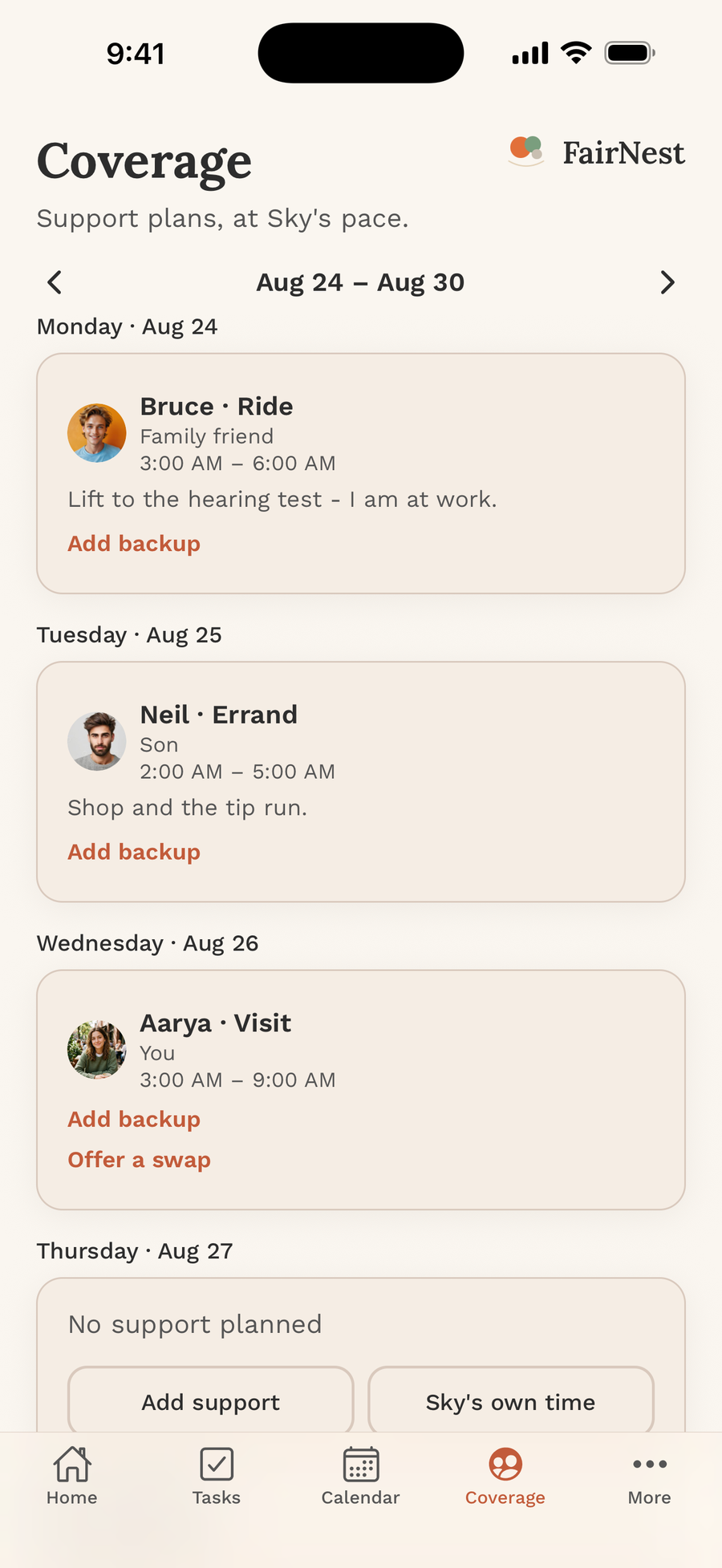
A coverage view like this one in FairNest means you always know who's with Dad this week without texting anyone. Handoff notes mean you can read the update the way you'd read a shift report — no guilt-trip phone call required.
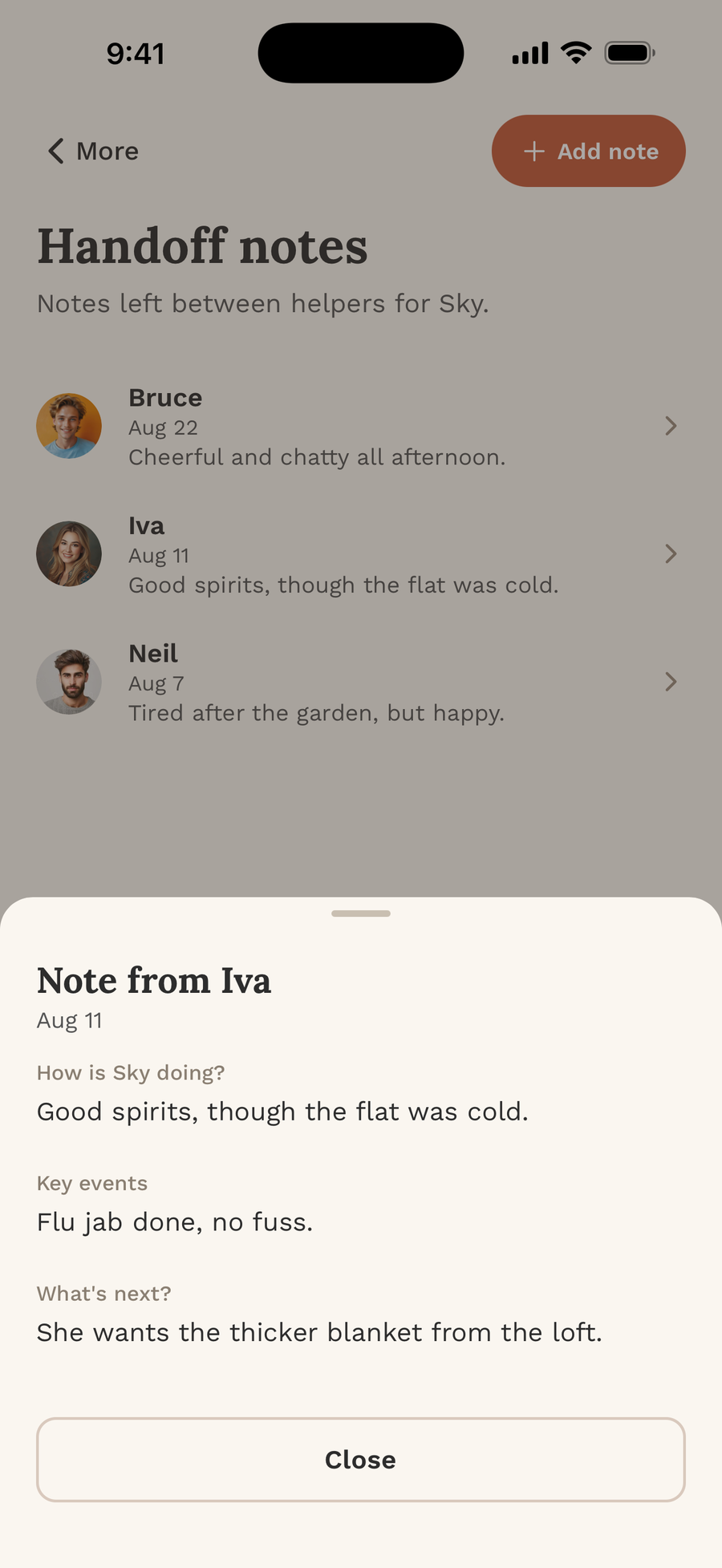
This matters more than it sounds. The siblings who fight most are usually fighting about information — who knows what, who decided what, who was told last. A shared log defuses that.
3. Make your presence predictable
Far-away siblings tend to show up in two modes: invisible, or heroic. Months of silence, then a frantic weekend visit where you try to solve everything in 48 hours and accidentally create more work for everyone.
Steal a page from the local sibling instead: care is a routine, not an event. Set up rhythms and keep them:
- A standing Sunday video call with Dad. Same time, every week.
- A standing Monday check-in with your sibling. Fifteen minutes: what's the plan, what do you need from me?
- Visit on a schedule, not in a crisis. Four planned weekends a year beat one emergency flight every time.
Predictability is what turns "the sibling who lives far away" into "the sibling who's got the bills, the refills, and Sundays." Geography versus a role in the family.
4. Put your money where your absence is
Let's be honest about something families tiptoe around: if you can't do the hands-on hours, you can often fund the load you can't carry. A few hours of respite care a week, the housekeeper, grocery delivery — real, material contributions, not consolation prizes.
The key word is transparent. When the spending is visible and the split is agreed on, money stops being the thing siblings fight about at midnight and starts being what it's supposed to be: a tool.
(This is general information, not financial advice — every family's situation is different. The principle is that contributions count whether they're hours or dollars.)
5. When you visit, be a teammate, not a guest
Finally, the visit itself. The classic far-away sibling visit goes like this: you arrive, everyone makes a fuss, your sister cooks for you and Dad, you take Dad out for one nice lunch, you leave — and your sister is somehow more tired than before you came.
Flip it. Arrive with a task list, not an itinerary. Ask your sibling in advance: "What are the five things I can take off your plate while I'm there?" Then insist your sibling take at least one full day completely off while you're in town. The best visit you can give the local caregiver is a day where they don't think about caregiving at all.
Why I built FairNest. FairNest is my own app, and I built it for exactly this problem: the far-away sibling flying blind while the local sibling drowns. A shared Nest for the whole family — tasks, coverage, handoff notes, cost splitting, med tracking — so everyone sees the same picture and the work stops living in a group chat. If any of this sounded familiar, it's at getfairnest.com, and you can find it on the App Store here: https://apple.co/4xRXJuq and on Google Play here: https://play.google.com/store/apps/details?id=com.bizvizorllc.fairnest.
Bottom line
Bottom line: you don't have to live nearby to show up — you have to be specific, predictable, and in the loop. Claim a lane, read the shared handoffs, keep the rhythm, and your siblings will feel you in the work, not just in the group chat.
Distance doesn't make you a bad sibling. It makes you a sibling with a different job. Claim the lane, keep the rhythm, make the invisible work visible — and when your phone buzzes at 10:47 p.m., you'll already know what's going on.
I share more of these family caregiving stories and practical playbooks on Instagram at https://www.instagram.com/fairnestapp/ — come say hi.