
The short answer: on one calm afternoon, get four documents in place — durable power of attorney, a health care proxy or advance directive, a HIPAA authorization, and a will or trust — gather the household's essential facts into one shared folder everyone can find, and walk the house for fall hazards. Done before the crisis, it's a gift; done during one, it's a scramble.
Picture this: it's a Tuesday morning, and your mom calls with an unfamiliar edge in her voice. Your dad fell in the bathroom last night. He's okay, but he's in the hospital, confused, and the nurse is asking questions your mom can't answer. What medications is he on? Who's his cardiologist? Does anyone have power of attorney?
Your mom says, "I think there's a folder somewhere. Your father handles all of that."
The crisis part of caregiving is largely unavoidable. The chaos part isn't — and learning how to prepare for a parent's medical emergency before it happens is what turns panic into a plan. Most of the panic families feel in that first week isn't fear — it's logistics. Where are the documents? Who can make decisions? Who even knows what's going on? All of that can be settled on a calm Sunday afternoon instead of a panicked Tuesday morning.
1. The four documents that matter most
Let's start with the paperwork — the part everyone dreads and the part that causes the most avoidable suffering when it's missing. These are the four documents hospital social workers ask about first (I'm not a lawyer, so treat this as a starting list to discuss with one):
- Durable power of attorney — lets someone you trust handle finances and legal matters if your parent can't.
- Health care proxy / advance directive — names the person who makes medical decisions, and records your parent's wishes about treatment.
- HIPAA authorization — lets named family members talk to doctors and see records. This one missing form stops more conversations cold than you'd believe.
- A will or trust — whatever fits your parent's situation; the point is that someone knows where it is and who's named.
This isn't legal advice — talk to an elder law attorney in your parent's state.
The documents don't have to be perfect. A done-enough plan you can find beats a perfect plan nobody can locate. Ask your parents: "Where are the papers, and who can act if you can't?"
2. What goes in a "just in case" folder for aging parents?
Underneath the legal layer sits the practical one: the hundred small facts that make a household run. When one parent handled all of that and they're the one in the hospital, the family is suddenly locked out of its own life.
One weekend, with your parent's help, gather this into one shared place:
- Bank accounts, insurance policies, and how bills get paid
- The full medication list and the doctors who prescribed them
- House basics: mortgage servicer, where the water shutoff is, who the plumber is
- Key contacts: attorney, accountant, financial advisor, neighbors with a spare key
- Passwords for essential accounts — stored securely, but accessible to the trusted person
The information stops being one person's burden and becomes the family's shared knowledge — the whole game is distributing the load before it breaks somebody.
3. Walk the house with fresh eyes
Most parents want to age in place. That's a fine plan, but it has to be an actual plan, not just a wish. Walk through the house the way a physical therapist would:
- Bathrooms: grab bars by the toilet and in the shower, a non-slip mat, a shower chair if balance is shaky. The bathroom is where most falls happen.
- Lighting: bright bulbs on stairs and in hallways, motion-sensor nightlights on the path to the bathroom.
- Stairs: handrails on both sides if possible, everything important moved to the main floor if climbing is getting hard.
- Trip hazards: loose rugs (remove or tape down), cluttered walkways, cords across the floor.
- Entry: a railing at the front steps, a lockbox so a family member can get in without a key hunt.
It's about buying years of independence with a few hundred dollars of hardware — worth doing before the fall. The after version costs far more, in money and in everything else.
4. When should you talk to aging parents about housing?
Someday the house might stop working: stairs become a hazard, the yard becomes a burden. If the first time you raise it is after a scare, it sounds like a verdict. Raise it now, over coffee, and it's just a conversation.
Try framing it as curiosity: "Mom, what do you love most about this house? What parts are getting to be a pain?" Listen more than you talk. Learn what she values — the garden, the neighbors, the kitchen — so that if a change is ever needed, you're solving for that, not just what's practical.
5. Call the meeting, not the group chat
Here's what turns good intentions into a plan: get everyone — siblings, parents — on one call or around one table. Thirty minutes. Agenda: documents, folder, house walk, housing thoughts. One owner per item, one deadline.
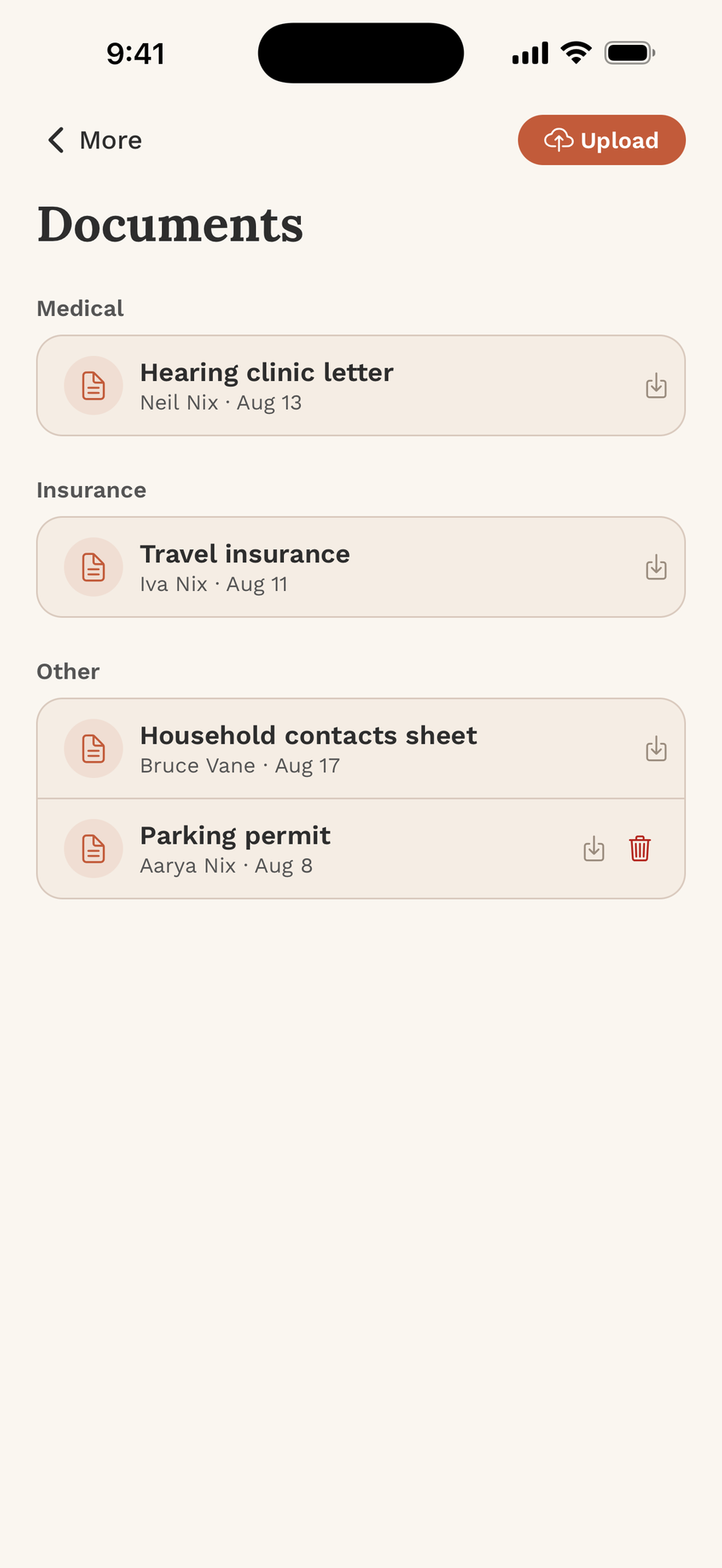
And this is the "why I built FairNest" part of the post. I started FairNest because I kept watching families run the most important coordination of their lives in a group chat. Documents nobody can find, tasks that evaporate, updates that scroll away. So I built my own app as the shared "Nest" where the plan actually lives: the task list with owners and deadlines, the coverage calendar, the handoff notes, the med list, the shared documents everyone can reach. Not a chat thread — a plan you can see. More at getfairnest.com.
Here's what that shared documents space looks like — no more "I think there's a folder somewhere":
If that kind of shared plan would help your family, FairNest is on the App Store here and on Google Play here — it's my own app, built to turn family caregiving from a group chat into a plan. More stories and strategies go out daily on Instagram at fairnestapp.
Bottom line
Bottom line: a parent's medical emergency is coming for most families eventually — the only question is whether the plan exists before it does. Four documents, one shared folder, one house walk, one family meeting: a calm afternoon now saves a panicked week later.
Planning ahead isn't pessimistic. It's the kindest thing you can do for the people you love — and for the version of you who gets that Tuesday-morning call someday. A calm afternoon, a few honest questions, a plan written down where everyone can find it. That's the gift.