
The short answer: build a two-minute handoff ritual — five questions every shift change answers: what happened today, what changed, what's the current state, what's pending, and what should the next person watch for. Write it down in one shared place, and the next person never starts from zero.
Hospitals have a sacred ritual. When one nurse's shift ends and another begins, they don't just wave and walk away. They stand together — sometimes at the foot of the bed, sometimes in a quiet hallway — and run through a structured handoff: what's going on with the patient, what changed today, what's coming next.
There's a name for it: bedside report. It's been studied, standardized, and built into the daily rhythm of every hospital on earth. Because here's what nurses know that most families are still learning: the moment care changes hands is the moment things fall through the cracks.
Now think about your family — and how to do a caregiver handoff between siblings without losing anything in the transfer. Dad comes home from the hospital, and your brother has been there all day. You arrive in the evening with groceries and questions. He gives you the handoff: "He was fine. Tired. Mom said the pharmacy called." That's it. Three sentences. You nod, he leaves, and twenty minutes later you're standing in the kitchen wondering — tired how? Did he eat lunch? Which pharmacy called, and about what?
Or maybe you're the long-distance sibling, the one who visits once a month and gets the handoff over the phone: "Everything's fine." And you believe it, because what choice do you have? Until the next visit, when nothing looks fine at all, and you realize "fine" was doing an enormous amount of work.
This is the problem the chaotic group chat was never going to solve. The group chat is a stream of moments — a photo of Dad's lunch, a "running late," a pharmacy number someone sends at midnight. Nobody re-reads a group chat like a chart. And nobody should have to.
What families actually need is the same thing hospitals figured out decades ago: a handoff ritual. A short, structured way to pass care from one person to the next without losing anything in the transfer. Here is how to build one.
1. Steal the nurses' template
Hospitals often use a framework called SBAR — Situation, Background, Assessment, Recommendation. You don't need the acronym; you need the idea. Every handoff should answer five questions:
- What happened today? (appointments, calls, visitors, how the day went)
- What changed? (new symptoms, mood shifts, anything unusual)
- What's the current state? (meds given, meals eaten, mobility, pain level)
- What's pending? (refills due, calls to return, appointments coming up)
- What should the next person watch for?
Five questions. Two minutes. That's the whole ritual. Write them on a sticky note on the fridge, or better, keep them somewhere everyone can see and add to. The point isn't to write a medical chart — it's to make sure the next person in the room never starts from zero.
2. Why should caregiver handoffs be written down?
Verbal handoffs evaporate. The brother who says "she seemed off today" can't elaborate three days later when a doctor asks what he meant. A short written note — in a shared place, not a text thread — becomes the family's record.
This is the founder's confession part of the post, so here it is: I built FairNest's handoff notes feature because I was solving this exact problem myself. My family's handoffs were collapsing — information lived in texts and phone calls, and every shift change leaked something: a missed refill, a doctor's instruction nobody wrote down, a symptom someone noticed but never mentioned. The app exists because I needed one shared place where the handoff was the product, not an afterthought: who's covering what, what changed today, what the next person needs to know. FairNest is my own app — I built it for exactly this problem.
Here's what that looks like in practice:
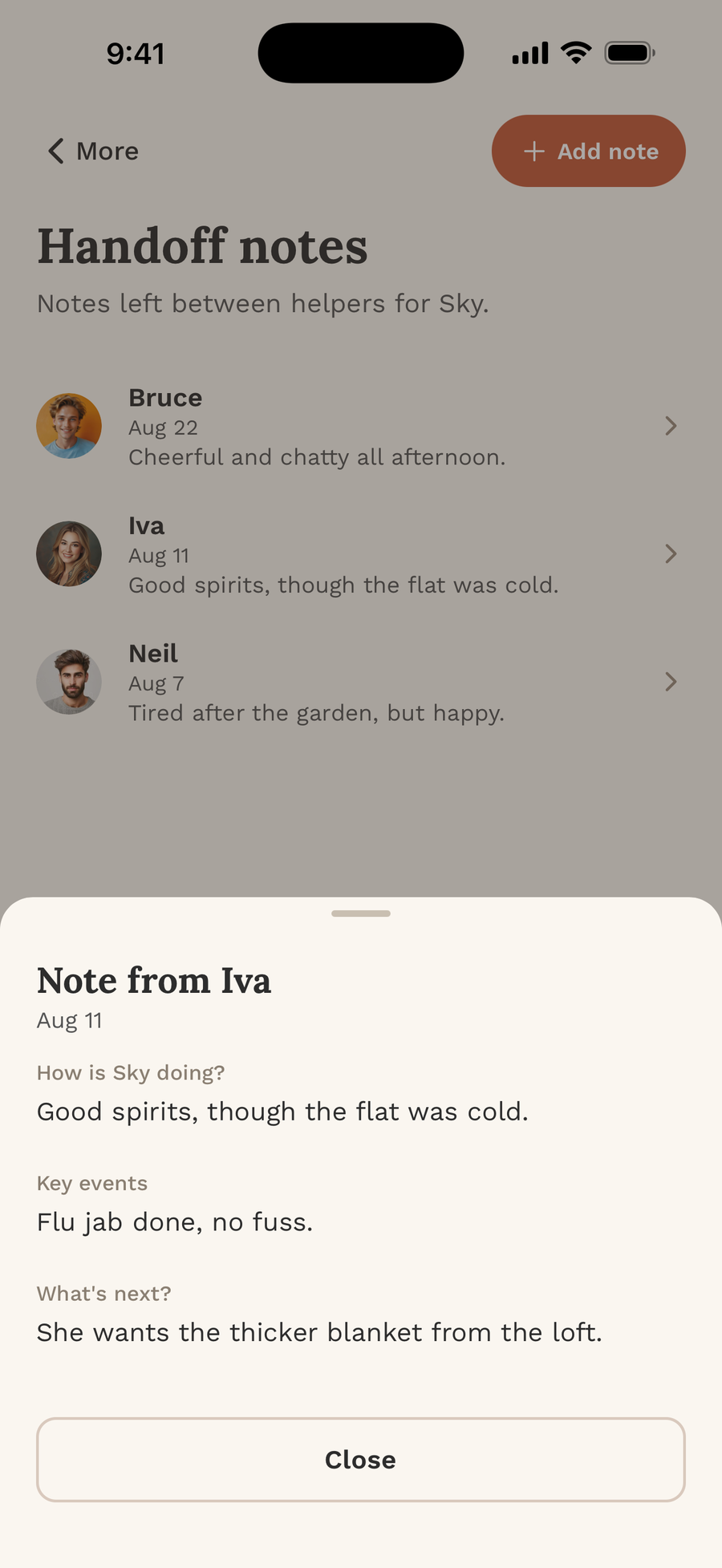
The bar for a good written handoff is low: dated, brief, visible to everyone in the Nest. "Tuesday: Dad ate half his lunch, refused dinner. New prescription picked up from CVS — starts tomorrow morning. Seemed more confused after lunch; will ask about it Thursday." That's thirty seconds of writing that saves everyone the next day.
3. How do you include the long-distance sibling in caregiving?
The sibling who lives 800 miles away will never stand at the foot of the bed for the handoff. So the handoff has to travel to them. This is the most common failure I hear about: the local caregivers develop their own rhythm, their own shorthand, and the distant sibling gets holiday-visit summaries that gloss over the texture of real weeks.
A written handoff fixes this automatically, because it's written down — anyone can read it. The distant sibling can check in on a Sunday, read the last few handoffs, and arrive at the monthly call already knowing that Mom's sleep has been rough for two weeks. That's a different conversation than "so how's Mom?" and it takes the local sibling off the hook for being the family narrator.
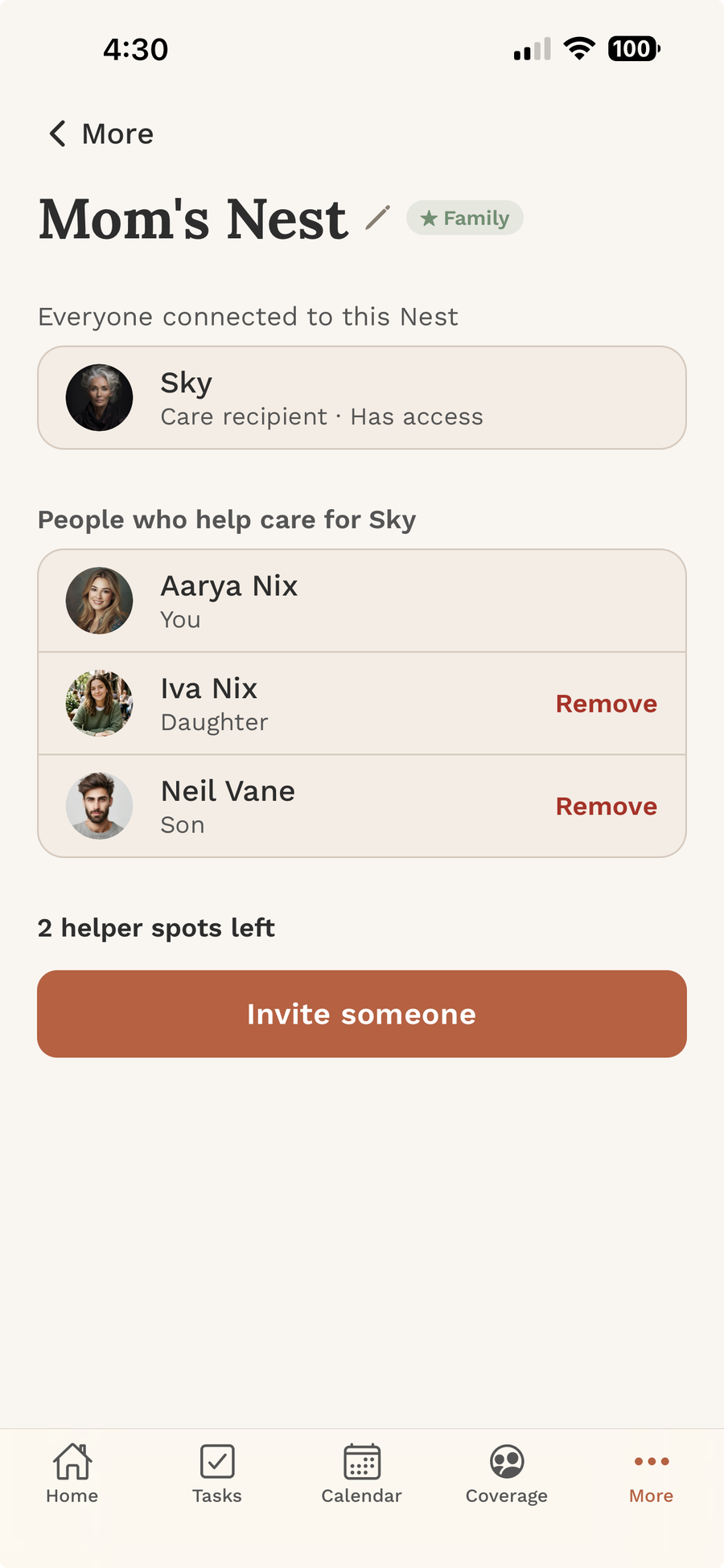
No one should have to call their sister just to find out whether Mom ate lunch on Tuesday.
4. Hand off the feelings too, not just the facts
Nurses hand off the patient's status. Family caregivers should hand off something else: each other's load. A good family handoff includes one line about the caregiver who's leaving, not just the parent who's staying. "I'm beat today — can someone take Thursday?" "Dad's appointment ran long and I'm fried."
This sounds soft. It's actually the highest-leverage part of the ritual, because burnout doesn't announce itself — it leaks out as resentment at Thanksgiving. A handoff that normalizes saying "I need help" is a handoff that keeps the team together. The shift change is the one moment every day when all the relevant people are paying attention. Use it.
5. Keep it short or nobody will do it
The fastest way to kill a handoff ritual is to turn it into homework. If it takes more than two minutes, the people doing the actual care work will quietly stop doing it — and they're right to. The people closest to the care are the most tired. Design for them.
So: five questions, plain language, no forms, no mandatory fields. A short note beats a perfect template that nobody fills out. And if someone skips a day? The next handoff just picks up where the last one left off. The ritual is forgiving by design, because caregiving already has enough rigidity.
Why I Built FairNest
I'm not writing this as a neutral observer. I built FairNest — my own app — because my family's handoffs were exactly the mess I described above: three-sentence summaries at the door, a missed refill, a doctor's instruction nobody wrote down. The shared Nest is the handoff made real — what happened today, what changed, what the next person needs to know, all in one place every sibling can read. If your family is still passing care by phone call and memory, you can see how it works at getfairnest.com.
Bottom line
Bottom line: care is only as good as the handoff. Five questions, two minutes, written down where everyone can see it — that's the whole ritual, and it's what keeps a caregiver handoff between siblings from leaking the details that matter.
The group chat will always be where your family sends the memes and the "running late" texts. That's what it's for. But care information — what happened, what changed, what's next — deserves its own lane, with its own ritual. Nurses figured this out because their patients' lives depended on clean handoffs. For families, the stakes are lower but the pattern is the same: the care is only as good as the handoff.
Set up your five questions this week. Try it for seven days. I think you'll be surprised how quickly "you're on your own" turns into "we've got this" — and how much lighter it feels to arrive knowing exactly what the day before held.
One note: this is general information about organizing family caregiving, not medical, legal, or financial advice — talk to your parent's doctor about what's right for them.
If passing care between siblings feels like a game of telephone in your family, you're exactly who I built FairNest for. It's my own app — a shared Nest where tasks, coverage, handoff notes, cost splitting, and med tracking live in one place, so every sibling is always reading from the same page. Take a look at getfairnest.com, download it on the App Store here: https://apple.co/4xRXJuq or on Google Play here: https://play.google.com/store/apps/details?id=com.bizvizorllc.fairnest — and follow along at @fairnestapp on Instagram.