
The short answer: early dementia rarely announces itself — it shows up as small, easily dismissed moments like misplacing things in odd places, repeating questions, or withdrawing from complicated tasks. One moment means little, but a pattern across weeks is worth writing down and taking to your parent's doctor.
Nobody in my family says the word "dementia" out loud. Not even now. What we said, for a long time, was things like: "Dad's just tired," and "Mom's always been scatterbrained," and "well, she's 78, of course she repeats herself."
The moment I can't shake happened on an ordinary Tuesday. I was visiting my parents and opened the fridge to grab the milk, and there was the TV remote, sitting next to the orange juice. My dad laughed. "Your mother," he said, rolling his eyes, and Mom laughed too, a little too brightly. Then later that week my sister called me: "Did you know Mom put her keys in the freezer last month? Dad told me when I was there in August."
We each had one piece of the puzzle. None of us had the whole picture — because none of us were writing any of it down.
What do early signs of dementia actually look like at home?
We expect dementia to announce itself dramatically. Sometimes it does. But early on, it usually looks like a series of small, strange, easily-explained-away moments:
- Misplacing things in odd places — and then insisting someone moved them
- Losing track mid-task — starting the laundry and walking away for six hours
- Repeating stories or questions within the same visit, without noticing
- Withdrawing from complicated things — the bills, the recipes, the driving directions they used to handle easily
- Personality flickers — uncharacteristic irritability, suspicion, or flatness
Any one of these has a dozen innocent explanations. That's the trap. Each moment feels too small to mention, so nobody mentions it, and the pattern stays invisible until something big happens — a fall, a missed medication, a scare on the highway.
This isn't medical advice — talk to your parent's doctor about what's right for them. But what I can tell you from the family side is this: the single most useful thing we did was start keeping a shared log of the moments that worried us.
How do you track early dementia symptoms as a family?
1. We stopped arguing about what "really happened" and started writing it down.
When my brother visited in October, he mentioned Mom had asked him the same question about the grandkids three times in an hour. Dad said it was "just nerves." It would have died there — except that by then we'd started keeping handoff notes in our shared Nest, the way we'd been doing for medications and appointments. So my brother wrote it down: Mom repeated the same question 3x during Saturday visit. Seemed unaware. When the doctor later asked "when did you first notice changes?", we didn't have to guess. We had dates.
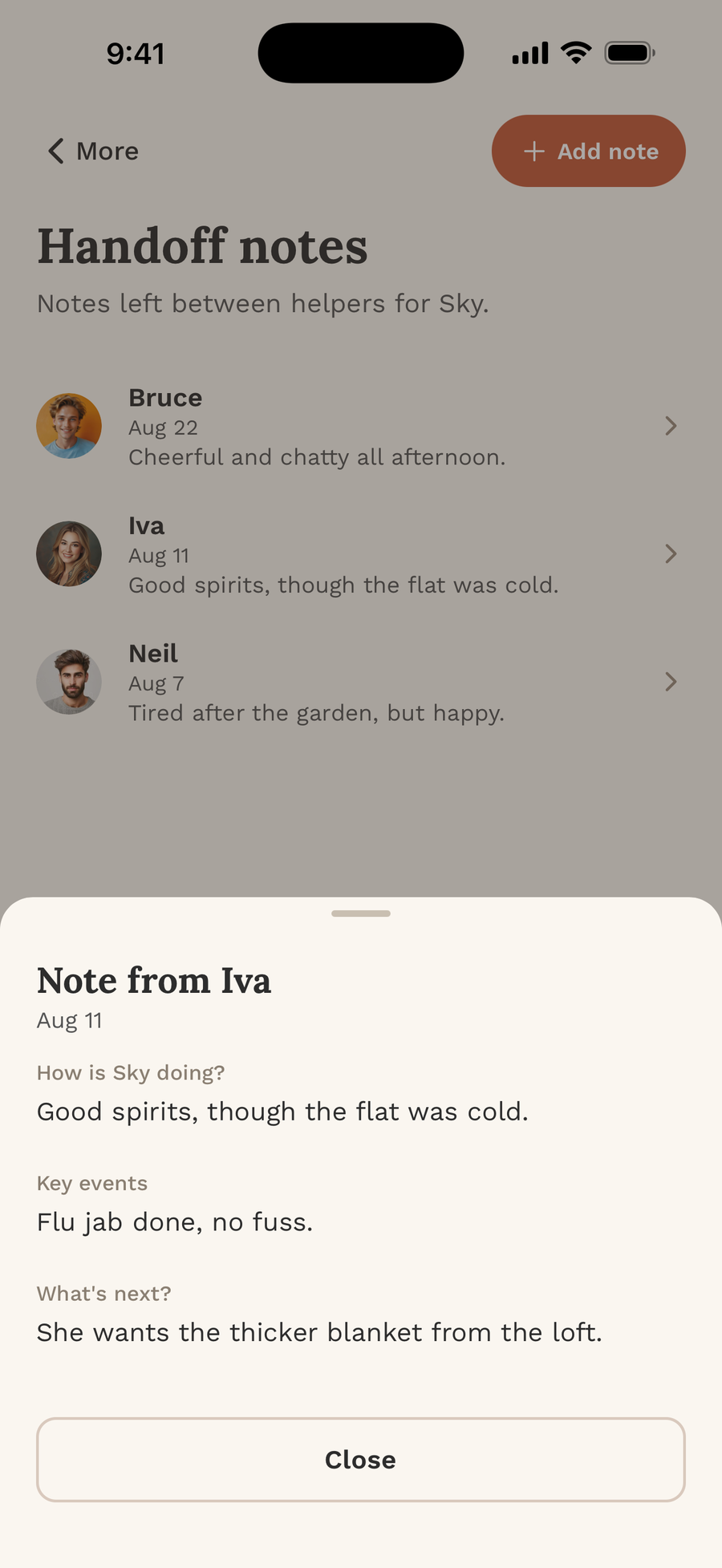
2. We treated observations like facts, not diagnoses.
This is the rule that kept the peace: write what you saw, not what you think it means. "Mom put the remote in the fridge" is an observation. "Mom has dementia" is a diagnosis, and it doesn't belong in a family group chat or a shared log — it belongs in a doctor's office. Sticking to facts kept my dad from feeling like we were ganging up on Mom, and it gave the doctor clean, useful information instead of family speculation.
3. We gave every sibling the same view.
Dementia changes don't show up evenly. Mom was sharpest in the morning and foggier by evening, and she performed beautifully for the sibling who visited once a month for Sunday lunch. The sibling who lived ten minutes away and stopped by on weeknights was seeing a different person — and starting to feel like she was imagining things. One shared record where everyone could see everyone else's observations validated the sibling who was seeing the most, and stopped the rest of us from dismissing her.
4. We used the pattern to act sooner, not to panic.
Here's what the log gave us that worry alone couldn't: timing. When we could show the doctor six months of small moments — the repeated questions, the burned pots, the confusion over the TV remote — she took us seriously immediately, instead of the "let's just watch it" response families so often get. Early didn't mean cured. But it meant a real evaluation, a safety conversation about driving, and a plan for the house months before anything forced our hand.
Why I built FairNest
I built FairNest — my own app, the one I now run my family's caregiving through — because of moments exactly like the remote in the fridge. Not because an app can diagnose anything, but because families like mine were losing critical information to the group chat: scattered across texts, remembered differently by everyone, and never in one place when a doctor asked the one question that mattered: when did this start?
If your family is in the "just tired / just scatterbrained" phase right now, start the log. Today. Not because something is necessarily wrong — but because if something is changing, the family that writes it down is the family that catches it early, acts calmly, and shows up to the doctor's office with something better than "we're not sure, but something feels off."
You can learn more about how a shared Nest works at getfairnest.com, and if it sounds useful, the app is on the App Store here: https://apple.co/4xRXJuq and on Google Play here: https://play.google.com/store/apps/details?id=com.bizvizorllc.fairnest. We also share real family caregiving stories over at instagram.com/fairnestapp — come say hi.
Bottom line
Bottom line: early signs of dementia in an elderly parent are usually small and easy to explain away — the power is in the pattern. Write down what you see, stick to facts not diagnoses, and bring the log to the doctor. The family that writes it down catches it early.
The remote in the fridge was funny that Tuesday. I still laugh about it, a little. But I'm glad we wrote it down — because it turned out to be the first line of a story we needed to read in full.