
The short answer: pick a split with your siblings before the next bill arrives — equal, proportional to income, or weighted by who's doing the hands-on care — write it down, log every expense in one shared ledger the day it's paid, and settle up monthly on a fixed date. When the money is visible, the arguments about it mostly disappear.
The home aide's invoice arrived on a Tuesday. $1,840 for the month. My brother had been fronting it on his credit card for three months — groceries, pharmacy copays, the plumber who fixed Mom's bathroom grab bar, all of it on his card, "we'll settle up later."
Later had arrived. He texted the family group chat a photo of the invoice and the words: "So who's covering what?"
And that, my friends, is how a $1,840 invoice nearly ended a perfectly good sibling relationship.
What followed was the kind of math argument only family can produce. My sister counted the times she'd driven Mom to appointments ("gas isn't free, you know"). I reminded everyone I'd paid for the stairlift repair out of pocket in January. Someone brought up 2019. It stopped being about the invoice and started being about every unspoken scoreboard we'd all been keeping for years.
Here's the thing: nobody was greedy, and nobody was lazy. We just never decided — out loud, in advance — how the money would work. So every expense became a fresh negotiation, and every negotiation dredged up an old one.
If you're in the thick of this, or you see it coming on the horizon, here's what we eventually figured out about how to split caregiving costs with siblings. It took us too long, and it doesn't have to take you that long.
1. Pick your split before you need it
There are really only a few models families use, and none of them is morally superior:
- Equal thirds (or halves). Simple, clean, and fair when everyone's roughly on equal financial footing.
- Proportional to income. The sibling earning more covers a bigger share. This only works if everyone can say the quiet part out loud: we can afford different things.
- Split by who's closest. The sibling who lives nearby does more hands-on care; the far ones cover more of the bill. This one acknowledges that time is also money.
The model matters less than the fact that you picked one together, on a calm Tuesday — not in a crisis, not in a text thread. Write it down. Even a single paragraph in a shared note beats a handshake promise made at the hospital cafeteria.
2. How do you track shared caregiving expenses so siblings stop arguing?
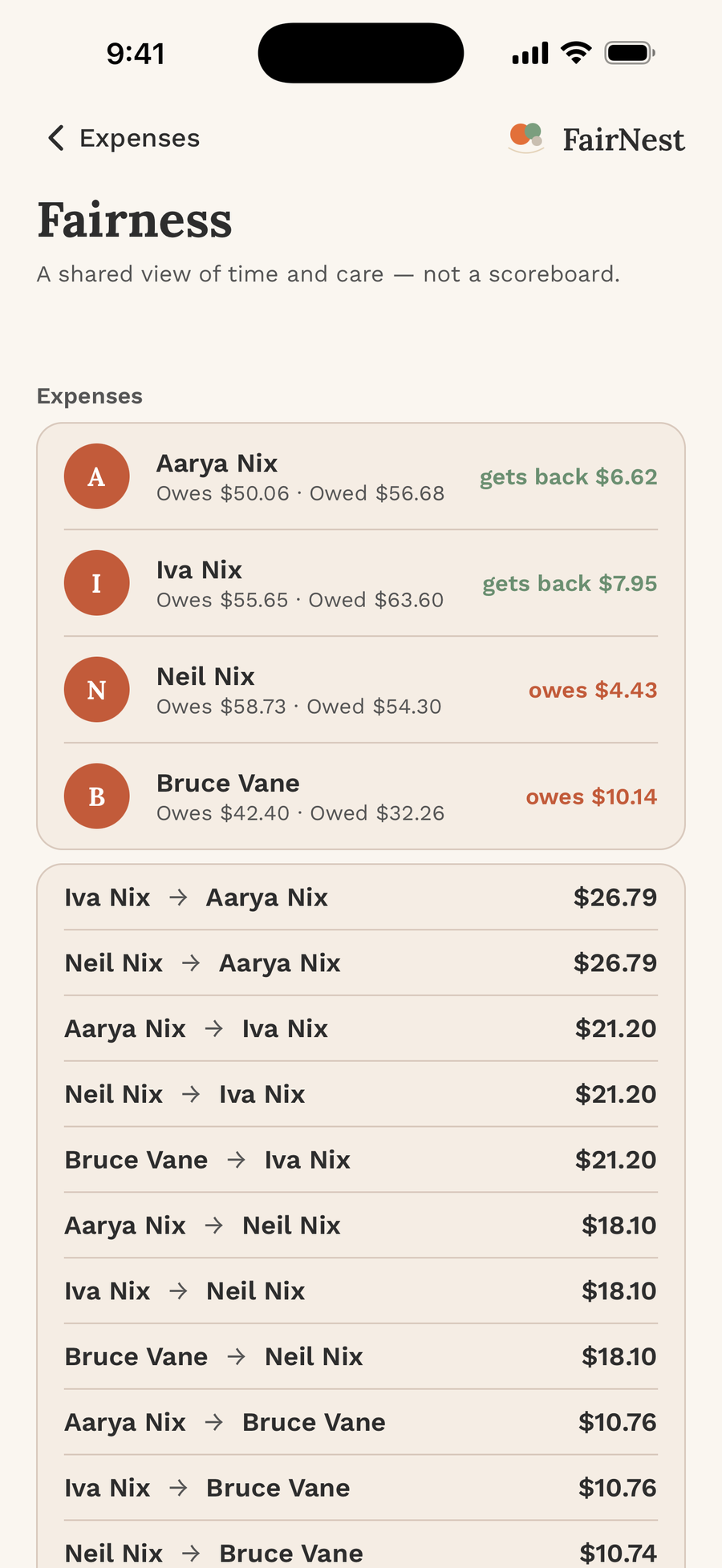
The silent killer of sibling goodwill isn't the amount. It's the fog. "I thought you paid the pharmacy." "I paid the pharmacy in May." When every expense lives in three different people's memory, every settle-up feels like an accusation.
We started keeping a running list — just a simple shared document: date, what it was for, who paid, how much. The rule was that anything entered within a day or two was gospel, and nobody got to retroactively dispute it six weeks later. That one rule did more for our relationship than any single conversation.
The moment expenses became visible, the arguments evaporated. Nobody was trying to cheat anyone. We were all just running different mental ledgers, and mental ledgers are where resentment grows.
3. Separate "shared costs" from "gifts"
This distinction saved us more than anything else. Not everything a sibling spends is a shared expense. When my sister hired a cleaning service to deep-clean Mom's apartment before her surgery, she didn't ask first — she just wanted Mom comfortable. Later, when she asked to be reimbursed, my brother balked: "I didn't agree to that."
New rule: anything over a threshold we'd agreed on ($100, in our case) needs a quick heads-up before it's spent. Below the threshold, enter it and get reimbursed, no questions asked. And some things stay gifts, freely given, never entered — the flowers, the fancy tea, the heated blanket. Giving without a spreadsheet attached still matters. It just needs to be clearly separate from the shared pot, or every gift starts feeling like a bill and every bill starts feeling like an obligation.
4. How often should siblings settle up caregiving costs?
Here's the pattern we fell into: expenses piled up for months, resentment piled up with them, and eventually someone exploded at a bad moment. The invoice was just the match.
Now we settle monthly, on the first Sunday, like paying rent. It's boring and predictable, and that's the point. Money conversations that happen on schedule never have to happen in anger. We each spend fifteen minutes, the balances get squared, and we go back to being siblings instead of accountants. Short, dull, done.
One more thing: rotate who "keeps the books" once in a while. The bookkeeper burns out too — and if one sibling is always the one tracking, it starts to feel like one sibling is auditing the others. Shared work keeps it shared.
Why I built FairNest
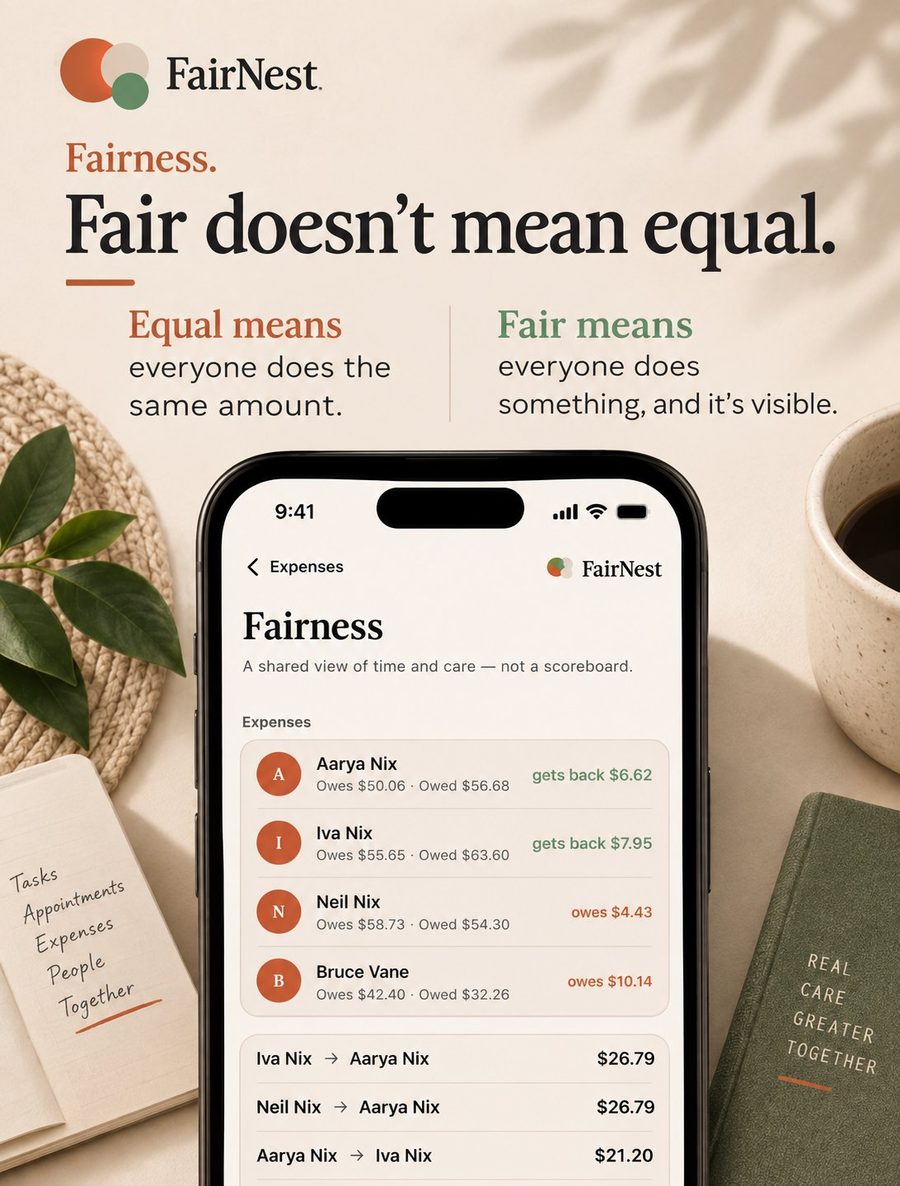
This is the exact mess I built FairNest for. I'm the author of this blog, and FairNest is my own app — the tool my family and I use to run our shared "Nest": the tasks, the coverage calendar, the handoff notes, and yes, the money. Every expense one of us pays goes into the Nest, the split we agreed on is already set, and at any moment any of us can see who's paid what. The first-Sunday-of-the-month settle-up takes about five minutes now, because there's nothing left to argue about. No more invoice photos in the group chat. No more 2019.
If the money conversation is the hard one in your family, a shared ledger that everyone can see is the single biggest thing that helps. You can learn more at getfairnest.com — and you can grab the app on the App Store here or on Google Play here and invite your siblings tonight. We also share real-world caregiving moments over on Instagram — come say hi.
Bottom line
Bottom line: sibling money fights are almost never about the amount — they're about the fog. Pick your split together, write it down, keep one shared ledger, and settle up monthly, and the invoice stops being the thing that ends the relationship.
Money fights were never really about money. They were about feeling unappreciated, unseen, and unsure whether anyone was keeping score the same way. The ledger doesn't fix the feelings — but it clears the fog so you can actually talk about them. Pick your split, write it down, keep one shared list, and settle up before it festers. Your siblings are the people who will hold your hand at the funeral and laugh with you at the wedding. An $1,840 invoice is a terrible thing to lose them over.
General information only — this isn't financial advice. Talk to a financial advisor or elder law attorney about your family's specific situation.