
The short answer: stop running your parent's care out of the family group chat and move it to one shared place — a coverage calendar with a name on every day, one living medication list, and written handoff notes. When everyone can see the same plan, "who's got Thursday?" gets answered before Thursday, not during it, and the sibling who's been quietly carrying everything finally gets seen.
"Who's got Thursday?"
If you're trying to figure out how to organize caregiving with siblings, you've either sent that text or received it. Probably both. It sits there in the family group chat, sandwiched between a pharmacy receipt photo, three "thinking of you" memes from your aunt, and a 47-message argument about whether Dad should still be driving.
Thursday never really gets answered. Or it gets answered three times by three different people, and then nobody shows up because everyone assumed someone else had it.
This is the part of caregiving nobody warns you about. The care itself is hard, but the coordination of the care — spread across siblings with jobs, kids, and different area codes — is what quietly breaks families.
Why doesn't the family group chat work as a care plan?
A group chat is a stream. Things flow past and disappear. That's fine for birthday plans. It's terrible for the question "did Mom take her morning meds?" because the answer scrolls away by lunch.
Here's what the group-chat care plan actually looks like in most families:
- The medication list exists as a blurry photo someone took of a pill bottle in 2024.
- The schedule lives in one sibling's head — usually the one who lives closest, which means they're also the one burning out fastest.
- Updates get repeated four times because nobody can find the original message.
- Money gets spent, nobody tracks it, and Thanksgiving gets awkward.
None of this happens because anyone is lazy or selfish. It happens because a chat thread is the wrong tool for shared work. You wouldn't run a project at work out of a group text. Caring for a parent is the most important project your family will ever run.
How do you organize caregiving with siblings so nothing falls through the cracks?
After watching my own family fumble through this, I became convinced the fix isn't better siblings — it's a better shared surface. One place where the whole picture lives, so nobody has to ask "who's got Thursday?" ever again.
Here's the shape of it:
A shared family care calendar with names on it. Not "someone should check on Dad Thursday" but "Maria — Thursday." When every visit, appointment, and overnight has a name attached, the mental load stops living in one person's head. And the sibling who always ends up defaulting to "I'll just do it" finally gets to see, in black and white, that they've done the last nine Thursdays.
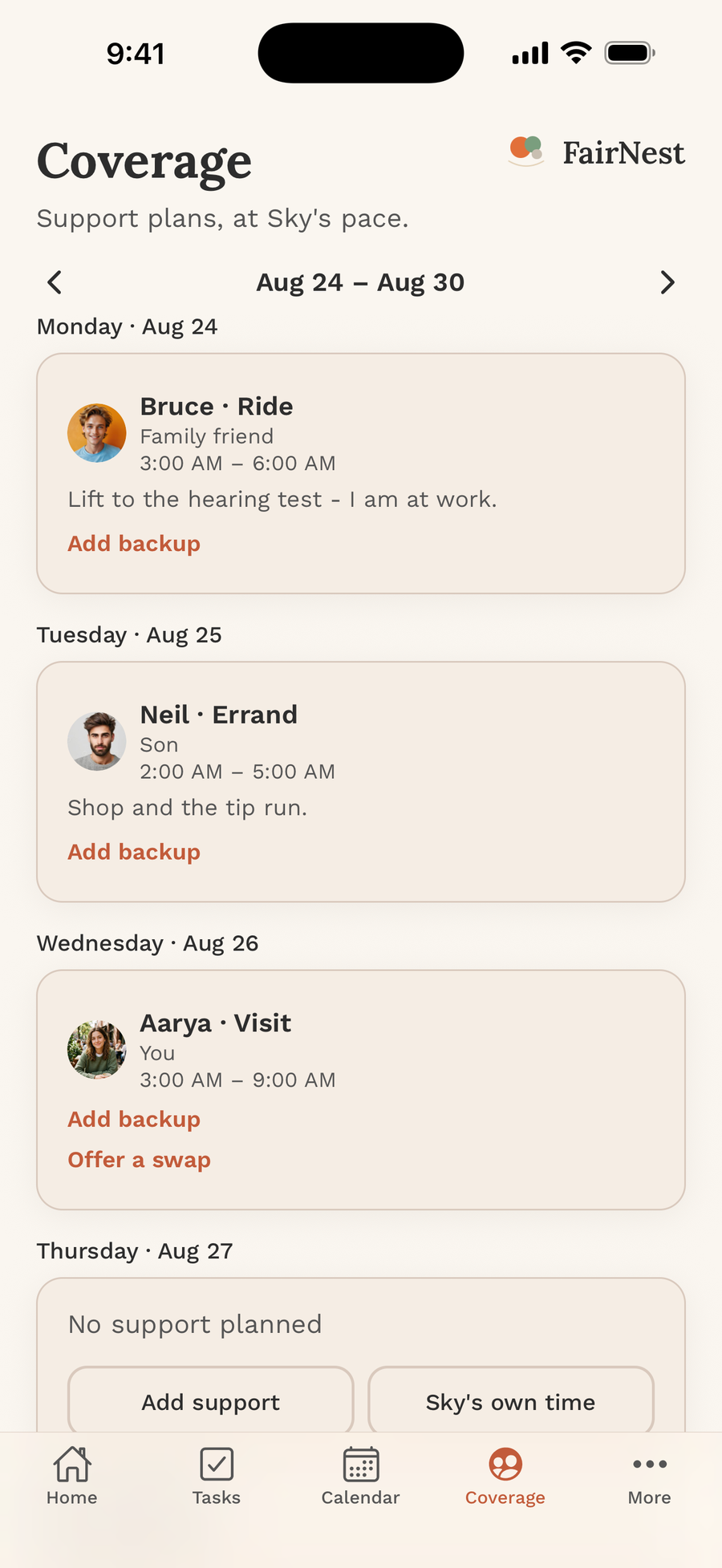 Coverage in FairNest: every day has a name on it. Gaps show up before Thursday, not during it.
One medication list everyone can see. Not a photo. A living list: drug, dose, time, who confirmed it. When the list is shared, the 9pm "did anyone give Mom her evening pills?" panic stops happening, because the answer is right there.
Handoff notes. This is the small habit that changes everything. Whoever was there last writes two lines: how Mom seemed, anything unusual, what's next. The next person walks in informed instead of guessing. It takes thirty seconds and it prevents so many mistakes.
Visible costs. Someone buys groceries, someone else pays the pharmacy, a third hires the cleaning help. Write it down in one shared spot. Money silence is where sibling resentment goes to grow.
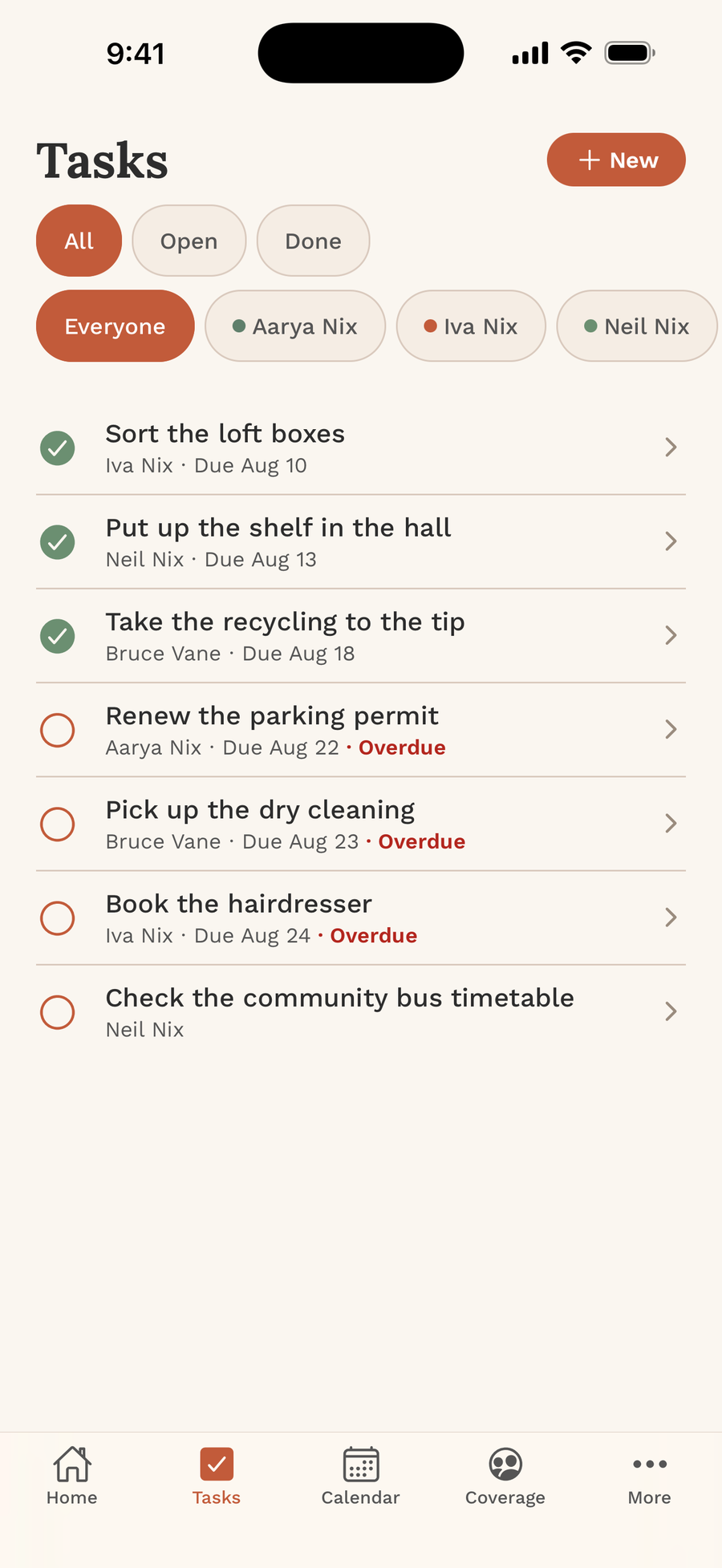 Tasks in FairNest: every job has a name and a due date, so nothing lives in one person's head.
None of this requires a family meeting or a big emotional conversation. It just requires agreeing — once — that the important stuff lives in one place instead of scattered across four phones.
The ten-minute Sunday habit
If you take one thing from this post, make it this: a ten-minute check-in, once a week, same time. It can be a call, a video chat, or even just everyone updating the shared plan for the week ahead.
Sunday evening works for most families. Each person claims what they can do that week. Gaps become visible before Thursday, not during it. The sibling who lives far away can take the pharmacy refills, the bill paying, the appointment scheduling — the invisible work that counts just as much as being there in person.
The magic of the weekly check-in isn't the logistics. It's that everyone stays in the loop, so nobody gets to drift into "I didn't know" — the four most expensive words in family caregiving.
Why I built FairNest
I'm not writing this as a neutral observer. I built FairNest because my family was living the group-chat version of this story, and I was the sibling with the spreadsheet trying to hold it together.
FairNest is the shared surface I wished we'd had: a private Nest for your family where tasks have names and dates, coverage is visible to everyone, handoff notes take thirty seconds, medications stay current, and costs are split without the awkwardness. It's free on iPhone and Android — find it on the App Store at https://apple.co/4xRXJuq and on Google Play at https://play.google.com/store/apps/details?id=com.bizvizorllc.fairnest.
I also share short, practical caregiving notes over on Instagram at @fairnestapp — including the story of the Thursday text that started all of this.
Bottom line
Bottom line: the group chat isn't a care plan — it's a stream where the important stuff scrolls away. One shared place for coverage, meds, handoffs, and costs is how you organize caregiving with siblings without the Thursday panic or the Thanksgiving blowup.
Start with Thursday
You don't need to overhaul everything today. Just answer one question, together, in writing, somewhere everyone can see it:
Who's got Thursday?
Put a name on it. Then do Friday. The system builds itself from there — one named, visible commitment at a time. Your future selves, the ones who aren't fighting about it at Thanksgiving, will thank you.